A philosophical perspective on constructing an information literacy education framework to foster college students’ complex thinking skills
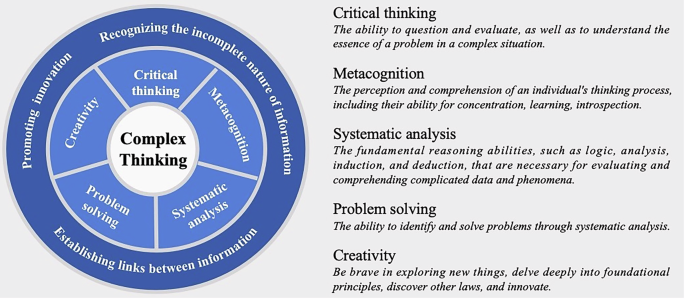
The educational content is designed around the specific objectives and core competencies for information literacy education to foster complex thinking. The proposed framework for information literacy education not only encompasses the development of technical skills but also integrates philosophical thought, emphasizing reflection on information generation mechanisms, training in systems thinking, and the cultivation of ethical awareness. This deep integration helps students develop complex thinking in the era of artificial intelligence, equipping them with critical thinking, metacognition, systems analysis, problem solving, and creativity. As a result, they are better prepared to navigate the intricate challenges of an information-driven society.
The content of information literacy education consists of five modules: Module 1: Information acquisition—Comprehending the fundamentals of information technology; Module 2: Information utilization—Constructing knowledge systems independently; Module 3: Information exchange—Dialogical academic research; Module 4: Information evaluation—Information ethics and security; Module 5: Future exploration—Interdisciplinary integration and innovative practice. The content of each module is meticulously centered on the cultivation of complex thinking and echoes the core elements of the latest version of the “Framework for Information Literacy for Higher Education”, as illustrated in Fig. 2. It should be noted that although the content of each module has its unique focus, they are interlinked and closely related. Consequently, the corresponding elements of the “Framework for Information Literacy for Higher Education” and the complex thinking skills emphasized in each module in each module only represent a portion of the overarching content focus. From a holistic perspective, the unified objective of all modules is to thoroughly enhance students’ information literacy and complex thinking. It is worth noting that this educational content framework, composed of five modules—information acquisition, information utilization, information exchange, information evaluation, and future exploration—is an original design tailored to the synergistic cultivation of information literacy and complex thinking.

Content of information literacy education for fostering complex thinking.
Module 1: Information acquisition—Comprehending the fundamentals of information technology
A thorough understanding of the information-generating process enables users to select information products that align with their informational requirements accurately. Information literacy education instructs students to use search engines, databases, and other resources to find information, while emphasizing the comprehension of the underlying principles of these tools, including the algorithmic logic of search engines and the classification and retrieval mechanisms of databases. Combined with the latest artificial intelligence technology, students are instructed in the concepts, principles, and methodologies of machine learning, deep learning, large language models, natural language processing, and open-source tool libraries. They acquire a comprehensive understanding of generative AI’s operational mechanisms and principles. By analyzing the corpora and models of various tools, students can more readily comprehend their advantages and limitations, enabling them to select the best tools and approaches according to their specific needs in practical applications.
Alongside comprehending the information generation mechanism, one must possess the ability to interact with information acquisition tools. The essential factor in effectively obtaining information is the implementation of appropriate search techniques and inquiry methods, namely identifying and extracting keywords, along with employing iterative search strategies. Based on the broad application of generative AI, international information experts have proposed prompt engineering (Cain, 2024; Lo, 2023a; Lo, 2023b), which is also the key content that information literacy education should focus on teaching at present. In essence, prompt engineering can be summarized as how to ask questions, that is, designing specific prompts, explaining the results generated by the prompts, and achieving the desired target effect by continuously iterating and optimizing the prompts. By teaching prompt engineering knowledge, such as Chain of Thought (CoT), knowledge-generating prompts, chain prompts, and Tree of Thoughts (ToT), students are provided with prompt strategies, techniques, and examples to help them more effectively acquire the desired information or content. For the construction of prompt words, school libraries can issue guidelines for prompt construction, similar to the “GenAI prompts” released by Deakin University Library (Deakin University, 2024). These guidelines assist students in recognizing prompt elements in generative AI, exploring the prompt mechanisms of generative AI, suggesting practices for effective prompting, and encouraging students to consider how to enhance the quality of generated content through prompt optimization. Many scholars have explored and constructed various structured prompt word frameworks, providing clear and practical guidelines for related practices. Among them, the CAST framework (Hwang et al. 2023), CLEAR framework (Lo, 2023a), and TRUST framework (Knoth et al. 2024) are some of the most notable representatives, which provide strong support for the application of generative AI.
Furthermore, students should be taught to critically evaluate the information they receive. With the development of information technology and the emergence of generative AI, the efficiency of information discovery, screening, and integration has been significantly enhanced, and individuals’ ability to discover information has been derived. However, the reliability of the acquired information is dubious. Numerous outcomes derived from big data and artificial intelligence tools rely on probability calculation of information, such as corpora, rather than stringent logical reasoning by humans, potentially leading to biased cognition and erroneous conclusions. During information literacy education, it is essential to develop students’ ability to discern information, enabling them to recognize the incompleteness of information. Students should be taught to assess, interrogate, and verify content, including assessing source reliability, evaluating accuracy, and identifying potential errors or biases. Fostering critical thinking skills in students is critical to facilitate knowledge creation.
Module 2: Information utilization—Constructing knowledge systems independently
Information literacy education should be grounded in constructivist educational theory and foster students’ ability to construct knowledge systems independently. The constructivist educational theory, proposed by the Swiss psychologist Piaget in the 1960s, scientifically elucidates the cognitive principles governing human learning, underscores the importance of independent and active learning, and posits that students are active constructors of knowledge rather than passive recipients (Piaget, 1970). The constructivist educational theory has profoundly influenced contemporary teaching and learning and has been dominant for an extended period of time (Waite-Stupiansky, 2022). However, in the artificial intelligence era, the constructivist educational theory has encountered unprecedented challenges. The development of technology such as artificial intelligence has simplified the process of information and knowledge acquisition, enabling students to obtain answers and complete final assignments by posing direct inquiries. This mode facilitates the relinquishment of the active construction of knowledge systems and self-improvement among educated individuals, resulting in a diminished capacity for exploration and innovation. Consequently, it may adversely impact students’ genuine learning experiences, depriving them of opportunities for authentic learning and skill enhancement, thereby obstructing the development of learning competencies.
Consequently, in the artificial intelligence era, information literacy education should further embrace the principles of constructivist education theory, equipping students with the ability to continuously construct new knowledge based on their own original experience. It enables students to actively obtain information across diverse disciplines, integrate the acquired information into their personal knowledge systems, develop a metacognitive ability for self-monitoring and regulation, and build systematic analytical abilities to address problems from a global perspective.
In information literacy education, teaching is not a unilateral transmission of knowledge but rather the processing and transformation of knowledge. Students might be directed to develop their own knowledge systems through several methods. The first step is to diminish the teaching knowledge units. Concise knowledge segments facilitate students’ learning and retention. Educators should deconstruct the knowledge pertaining to information retrieval and arrange it into concise and coherent “knowledge strings” that facilitate student comprehension while allowing for the reorganization and innovation of key concepts. Secondly, the duration of solely theoretical instruction should be diminished, the complexity of theoretical content should be alleviated, and the training in diverse skills should be augmented. The course content should condense the introduction of diverse academic resources and theoretical methodologies while enhancing the explanation of AI literacy, data literacy, inquiry, cooperation, and communication to promote the diversification of students’ knowledge structures. This allows students to obtain essential knowledge and incorporate it into their existing knowledge structures, thus enhancing and refining their knowledge systems. The third is to implement scenario simulation and project-based learning methods. This includes designing specific application scenarios around a complex issue (e.g., climate change, artificial intelligence ethics), requiring students to collect information across disciplines, decompose complex concepts through systematic analysis, and subsequently devise solutions. The fourth step is to construct a personal knowledge map. Students can systematically arrange their acquired material by utilizing mind maps or knowledge management tools to create a personalized knowledge system.
Module 3: Information exchange—Dialogical academic research
The focus of this module is to encourage students to engage in dialogic academic research and to cultivate their ability to identify and establish connections between information through academic communication. The ideas of an individual are always constrained; however, when numerous individuals with similar research directions convene for collaborative dialog and discussion, it becomes more feasible to enhance the systematic comprehension of the issue and to investigate potential solutions. Integrating the information literacy education framework into the academic research and exchange system enables students to generate a “resonance effect” during interactions, fostering new discoveries and advancements.
The roles of teachers and students in information literacy education should be transformed from a traditional “teaching-oriented” approach to a “learning-oriented” and “dialog-oriented” perspective. As information is more easily accessible, students can easily expand their knowledge. Consequently, teachers will evolve from mere dispensers of knowledge to facilitators of learning experiences, while students will transition from passive recipients to active seekers of knowledge. This transformation shifts education from a unilateral knowledge transfer to an active, immersive, co-creative activity.
Specifically, problem-oriented, task-driven, flipped classroom, brainstorming, and other outward-looking pedagogical methods can be utilized in a personalized manner, facilitating the sharing and exchange of ideas through communication, commentary, discernment, and inquiry (Orhan, 2023). These approaches encourage inter-collective discussions and idea exchanges, thereby fostering students’ active reconstruction of knowledge connections and the continuous exploration of new information. We can specifically assign individualized learning challenges to students and guide them in attempting to resolve these assignments, for instance, developing “scaffolding” activities for students that require AI intervention and information exchange (Houston and Corrado, 2023). “Scaffolding” refers to a pedagogical approach derived from constructivist educational theory, utilizing the metaphor of “building scaffolding” from the construction sector. It posits that student learning is an ongoing ascent, with educators consistently supplying “scaffolding” instructional resources to facilitate the teaching and learning process and enhance students’ knowledge and skills to elevated levels. Through gradual “scaffolding” projects, students are guided to solve complex issues via dialog-driven academic inquiry and consistently tackle new challenges.
Furthermore, students should be motivated to engage in diverse learning groups, academic communities, and participate in academic conferences, eschewing solitary work in favor of fostering new discoveries through academic debate and exchanges.
Module 4: Information evaluation—Information ethics and security
Within the realm of AIGC, information sources are broad and intricate, presenting challenges related to information ethics, morality, and security. This module mainly educates students on the ethical and responsible utilization of information, emphasizes respect for the intellectual property rights of others, standardizes the citation of external results, and appropriately implements generative AI in accordance with rules and regulations. In particular, the rapid development of generative AI technology has brought ethical and legal challenges. Information literacy education should emphasize the significance of ethical responsibility and legal awareness for students utilizing generative AI tools, ensuring they comprehend and adhere to the ethical principles of artificial intelligence, uphold academic integrity, and protect copyrights. They should also learn to use generative AI technology in accordance with legal regulations and understand how to properly cite AI-generated content, including citation formats, author attribution, and copyright ownership, to ensure its appropriate use in academic research. In addition, as the AIGC generation process involves the extraction and integration of material from multiple sources, along with the absence of indicators regarding the origin of the information, students may unintentionally violate intellectual property rights. Therefore, information literacy education should focus on instructing students on how to trace information sources to guarantee accurate knowledge attribution. Overall, students need to clearly understand the difference between information rewriting and information innovation to promote practical and beneficial information innovation.
Furthermore, tools such as AIGC will persist in gathering individualized user data through ongoing interactions—encompassing behavioral patterns, knowledge levels, cultural attitudes, and more—in order to construct a comprehensive user profile. In the process of acquiring information, particularly through generative AI, students frequently become inadvertent sources of information. Students must recognize that when utilizing tools like AIGC, they should pay attention to protecting their privacy, exercise caution and objectivity in articulating their perspectives, and assume accountability for their statements.
Module 5: Future exploration—Interdisciplinary integration and innovative practice
Future exploration of information literacy education that fosters complex thinking may produce infinite opportunities through interdisciplinary integration (Amelink et al. 2024). Transcending conventional academic boundaries and adeptly integrating diverse knowledge, skills, and methodologies creates unprecedented possibilities for innovation.
Artificial intelligence technology has instigated significant transformations across many fields, including medicine, sociology, economics, and fundamental sciences, resulting in the emergence of numerous interdisciplinary subjects. Modern science is exhibiting a tendency towards interdisciplinary integration (Newman-Griffis, 2025). Information literacy education is a curriculum that incorporates and integrates science and technology, characterized by interdisciplinary integration and the properties of science across disciplines. Moreover, the purpose of information literacy education in fostering complex thinking is to cultivate several skills, including critical thinking, metacognition, systematic analysis, problem solving, and creativity. Thus, the cultivation of complex thinking cannot depend exclusively on the expertise of a single subject; it must transcend disciplinary boundaries and facilitate the integration and fusion of multidisciplinary knowledge and skills.
In this future exploration module, interdisciplinary knowledge, such as computer science, psychology, and sociology, will be incorporated to broaden students’ knowledge horizons. Through interdisciplinary learning, students can better comprehend the application and significance of information across various domains, fostering the cross-integration and creative advancement of their knowledge frameworks. It should be noted that the interdisciplinary integration of information literacy education aims to break down barriers across fields and forge significant and important links among them. This process is not merely a simple superposition of teaching activities across various disciplines under the same topic; it necessitates the integrative application of knowledge concepts, cognitive approaches, and investigative skills from multiple fields during problem-solving, emphasizing the interconnections among the disciplines.
Information literacy education can employ a comprehensive unit and extensive task teaching structure to facilitate interdisciplinary learning activities through projects or problems. Interdisciplinary real-world problems are derived from real-world events. These problems are typically persistent and complex. Consequently, the problems must be further deconstructed, and transferable interdisciplinary learning activities can be facilitated by developing a number of interconnected problem chains. The curriculum of information literacy education is closely focused on the real problems to be solved, enabling students to effectively organize and apply their prior knowledge in specific contexts, engage higher-order cognitive strategies such as problem-solving and systematic analysis, foster deep learning, and ultimately facilitate learning transfer and innovative practice. In this process, concept maps can be used to facilitate the horizontal connection of core concepts across different disciplines. At the same time, the specific objectives of information literacy education can be attained through the systematic cultivation of complex thinking in a hierarchical structure, thereby preventing aimless indoctrination and the execution of fragmented learning activities.
link