Beyond mixed methods: a pluralist approach to objects in interdisciplinary teaching and learning
Object dynamics
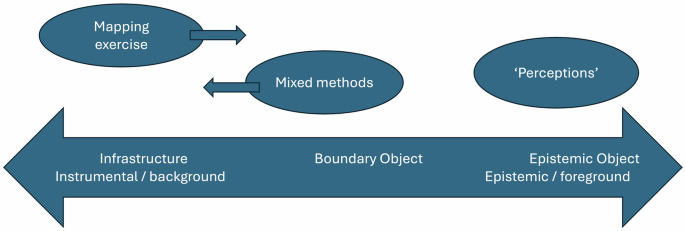
The concept of boundary objects provides a powerful analytical lens that has been extensively and productively applied to interdisciplinary research settings. Nevertheless, as Star (2010) and Nicolini et al. (2012) argue, the concept can be stretched too far, sacrificing its analytical specificity and explanatory power. Indeed, all three objects that we examined above could probably be approached as boundary objects. Nevertheless, we find the relational dynamics of these objects more significant than their classification when exploring the role they play in relation to interdisciplinary learning. Drawing loosely on the analytical framework presented by Nicolini et al. (2012), we suggest interpreting the role taken by these objects as movements along a continuum ranging from fully instrumentalised objects relegated to the infrastructural background of the interdisciplinary interactions; across the bridging, middle ground of the boundary object; and extending to the foreground of epistemic objects that may, ultimately, act as thresholds for interdisciplinary learning (see Fig. 1 below).
Understanding interdisciplinary object dynamics as movements along this continuum provides a foundation, we argue, for questioning and discussing what constellations of objects, student preconditions, and teaching input that may be conducive to interdisciplinary learning. In the following, we focus this discussion on 1) more or less troublesome kinds of differences; 2) the potential that objects at the epistemic end of the spectrum may act as interdisciplinary learning thresholds, and 3) the roles of improvisation and scaffolding.
Different differences
Differences are important to interdisciplinary learning. Indeed, as presented in the analysis above, the groups with the starkest disciplinary differences seemed to be those with most at stake in terms of interdisciplinary learning (Land, 2012). The literature on boundary objects emphasizes the crucial point that “consensus is not necessary for cooperation nor for the successful conduct of work” (Star and Griesemer 1989, p. 388). Yet, interdisciplinary differences can be conceived and mitigated in a variety of ways that are more or less conducive to interdisciplinary learning. As we saw in the analysis, the bridging role of a boundary object, such as mixed methods, can be conducive to efficient interdisciplinary collaboration. However, in an educational setting, the dominant mixed-methods approach to interdisciplinarity holds the risk of affirming disciplinary boundaries rather than enabling their transgression, object and encouraging a surface approach to learning (Entwistle & Tait, 1990).
As we saw in group A, the mixed methods approach to interdisciplinarity was reflected in the way in which the students approached their differences: Students who perceived their internal differences primarily at the level of methodological expertise dissimulated interdisciplinary differences to dots along a mono-dimensional continuum. This was efficient in the sense that it rendered their differences unproblematic and manageable. With the perception that combining ‘qual’ and ‘quant’ in the same report rendered their project interdisciplinary, mixed methods did take on the role as a boundary object. In fact, it rendered interdisciplinarity so unproblematic that the mixed methods object itself quickly receded into the background, taking on some of the instrumental characteristics of an infrastructural object (Rheiberger’s distinction between instruments and epistemic things resonates here, see Knorr Cetina, 1997: 13).
Clearly, the interdisciplinary teaching learning dynamics that unfold around objects are shaped by a multitude of factors, many of which are related to student positionality and learning attitudes. Yet, our exploratory findings suggest that the objects themselves and their relational dynamics also matter for how the students perceive and deal with differences. In contrast to the methodologically defined differences illuminated by mixed methods, the differences that surfaced around the notion of “perceptions” were much more resistant to assimilation. Had the constellation of disciplinary backgrounds been different in the group, this might not have been the case. An anthropology, a sociology, and a human geography student might have been able to mutually accept ‘perceptions’ as a boundary object, proceeding their investigation while—potentially—working from slightly different understandings of the object. Situated at the encounter of an anthropology and an economics student, “perceptions” proved much more troublesome: a central concept to one discipline while alien to the other. In this interdisciplinary constellation, the concept of “perceptions” could not easily function as a simple bridge between disciplines, instead revealing fundamental differences in how each field understands and values knowledge itself—a realization that pushed students to critically examine their disciplinary assumptions.
Boundaries to thresholds
Originally introduced by Meyer and Land in 2005, threshold concepts are defined as those key ideas that allow learners to break through significant barriers, enabling a deeper understanding within a particular discipline. Threshold concepts are characterized as transformative, troublesome, irreversible, integrative, bounded, constitutive, and discursive (White et al., 2016). While these characteristics have typically been applied to disciplinary learning, they also provide a helpful framework for understanding interdisciplinary education, where students must navigate and cross boundaries between different knowledge domains (Land, 2012; Holley, 2018).
For the purposes of the following discussion, we draw inspiration from the work of Meyer & Land (2003, 2005, 2006), Land (2012) and Carmichael (2010) when we refer to thresholds for learning. By this, we mean the critical moments students must navigate to achieve deeper interdisciplinary learning—those pivotal points that enable them to cross disciplinary boundaries and develop new ways of thinking. In particular, we focus on how specific objects or concepts can serve as these thresholds, guiding students through the process of interdisciplinary learning. In this regard, Land (2012) suggests that interdisciplinarity itself might function as a threshold concept, enabling students to traverse disciplinary “tribal” boundaries. By challenging students’ pre-existing ideas about disciplines, interdisciplinarity fosters a deeper understanding of boundary-crossing itself.
Carmichael (2010) offers a slightly different perspective, examining how disciplinary thresholds can facilitate interdisciplinary collaboration. Rather than interdisciplinarity being the threshold, he argues that key concepts within each discipline can serve as thresholds, enabling students to bridge gaps between fields. These disciplinary thresholds help articulate the differences between perspectives, thus creating opportunities for interdisciplinary learning (Carmichael, 2010, p. 59). In this way, threshold concepts not only mediate interdisciplinary encounters but also serve as gateways to deeper, more integrated learning.
By looking at objects and concepts as potential thresholds, we can explore their role in promoting interdisciplinary learning. In our case study, the concept of “perceptions” emerges as a threshold for interdisciplinary learning. Extending the threshold concept framework from mono-disciplinary to multi-disciplinary contexts (Carmichael et al., (2007); Holley, 2018), we observe how confronting different disciplinary epistemologies related to ‘perceptions’ led students to a new level of understanding. Meyer and Land (2005) describe threshold concepts as those that help students pass through a conceptual gateway, enabling access to new ways of thinking. This aligns with the work of Geertz (1973), whose influential essay on thick description forms the foundation of cultural anthropology. Geertz argues that what we call data is not just raw information but our own interpretations of other people’s interpretations of their actions. He writes, “what we call our data is really our own constructions of other people’s constructions of what they and their compatriots are up to” (Geertz, 1973, pp. 3-30). The recognition of this layer of interpretation, as presented by Geertz, becomes an important threshold in the trajectory of disciplinary learning within anthropology. For the economics student in our study, the anthropologist’s emphasis on perceptions as valid, interpretive data was a transformative realization. The concept of ‘perceptions’ thus acted as a threshold that helped students move beyond disciplinary boundaries, forcing them to reconsider what constitutes evidence and analysis within different disciplines.
In this context, “perceptions” became a key interdisciplinary learning threshold, prompting a shift in the students’ understanding of both disciplinary differences and interdisciplinary integration. As Land (2012) notes, understanding the value and purpose of interdisciplinarity requires not just a conceptual shift but also an ontological one. In this case, ‘perceptions’ created a space for that shift, enabling both the anthropologist and the economist to gain new insights into each other’s disciplinary logic. This is reminiscent of Carmichael’s (2010) idea of the “articulation of difference,” where students begin to appreciate the epistemic concerns of other disciplines.
Ultimately, “perceptions” in this study exhibited many of the characteristics of threshold concepts, being bounded in that the students’ discussion highlighted the boundaries of their respective disciplines. At the intersection of anthropology and economics, perceptions were also troublesome, acting as an object that was foundational to one discipline but alien to the other. These conflicting evaluations of the concept’s analytical value within the two fields pushed students toward a deeper understanding of the interconnectedness of concepts, epistemologies, and disciplinary positions. In this way, “perceptions” became integrative and, eventually, transformative, requiring the students to shift their positions in relation to the topic (Meyer & Land, 2005; White et al., 2016).
By examining how ‘perceptions’ acted as a threshold for interdisciplinary learning, we see how certain concepts or objects can facilitate boundary-crossing and enable students to engage in deeper, more integrated learning across disciplines. Threshold concepts, whether in the form of disciplinary ideas or boundary objects, thus serve as critical points that allow students to move beyond initial understandings and achieve transformative interdisciplinary learning.
These observations have important consequences for how we approach interdisciplinary teaching and learning. If the goal is to encourage deep learning through the transformation of boundary objects into thresholds, there seems to be substantial potential in setups that encourage interaction across explicitly different and potentially conflicting disciplinary positions—exploring “un-common ground” in a multidimensional disciplinary space (Lindvig et al., 2017). Conversely, a one-eyed focus on commonalities and shared objects (as is often the case with mixed methods) risks undermining the potential for deeper learning through threshold crossing by allowing the students to believe that they already know what is going on and already agree on what to do. Here, we discuss what the case study tells us about improvisation and scaffolding as pathways out of this kind of consensual boundary-maintenance.
Consequences for teaching: improvisation and scaffolding
The learning potential of emergent epistemic objects, such as ‘perceptions’, is significant and encourages us as teachers to be responsive and embrace a certain element of improvisation in the teaching-learning environment (Cerwonka, Malkki (2007)). The dynamics reported here point to the potential inherent in a teaching-learning environment that makes room for open-ended discussions where the “articulation of difference” can take place. Carmichael draws a contrast between such an environment and “established approaches to … interdisciplinary work, which characteristically involves a team being deliberately constructed to solve some pre-existing and well-defined problem” (Carmichael, 2010, p. 58–59}. These approaches may have benefits in terms of research project management. In a teaching-learning context, however, they risk undermining deep learning across disciplinary difference. Much like mixed methods (and often in combination with such a perspective), they provide a certain level of closure from the start; an agreement on the problem at hand and/or on the relevant articulation of disciplinary difference being in terms of qual and quant methods. This closure in turn discourages the kind of open-ended articulation of difference that we saw in group C.
That said, as with learning in general and interdisciplinary courses in particular, it is necessary to balance improvisational openness with appropriate scaffolding (McCune et al. 2021 p. 1529). The mapping exercise introduced during one of the initial classes was an attempt to provide an infrastructure for what Onwuegbuzie & Leech describe as “re-framing” (Onwuegbuzie & Leech 2005, p. 328). The exercise encouraged students to step back from mixed methods, prompting them to address the philosophical underpinnings of disciplinary differences, reflecting on concepts like ontology and epistemology.
For students well versed in philosophical concepts, the exercise acted as scaffolding for deeper interdisciplinary collaboration. While it did not seem to provide the immediacy and openness for articulating differences as the spontaneous discussion on “perceptions” it may have provided scaffolding even here: indeed, the group that took up this discussion also embraced the mapping exercise as a tool for inspiration. Other students, possibly the majority, faced varying degrees of resistance to the philosophical vocabulary of the exercise. This was particularly the case, it seemed, for those with an interdisciplinary background (e.g., in group B) who may not have had the same exposure to philosophy of science as those who had gone through a monodisciplinary education. Yet, even for these students, the mapping exercise offered a practical means of organizing research ideas whether in the planning or data collection stages. Similar outcomes have been observed using physical tools for collaboration, such as CoNavigator, and even digital tools such as Miro (van Lambalgen & de Vos, 2023). While structuring work effectively, it did not lead to the same depth of discussion on disciplinary differences observed in other scenarios.
We believe that part of the explanation for this lies in the abstract level at which the exercise was organized. What “perceptions” provided for group C was a concrete and project-relevant illustration that simultaneously held the potential to act as a threshold for interdisciplinary learning due to the fundamental ontological and epistemological premises inherent in the concept. One could, indeed, think of other examples that might play the same role—the introduction of which could be prepared in advance by the teacher.
For example, during a later interdisciplinary/mixed methods course on livelihood analysis, co-taught by the first author and a colleague specialized in quantitative analysis, the notion of the ‘household’ was introduced in much the same way. Holding a crucial position within both resource economics and rural anthropology, the household concept provided a boundary object rife with potential as a threshold for interdisciplinary learning. On the one hand, the anthropologists (and others with a primarily qualitative/interpretive social science background) participating in exercises in quantitative livelihood analysis were hard pressed to recognize the necessity of having one uniform definition of a household to enable quantitative, comparative analysis. On the other hand, the economists (and others with a primarily quantitative/causal social science background) were forced to recognize the inevitable malleability and variation of rural households when confronted with ethnographic evidence and discussions based on multiple rural locations. The concept of ‘household’ was analytically valued in both disciplinary camps—and thus less troublesome than “perceptions”. Yet the disciplinary approaches to the concept differed to such an extent that, with the necessary scaffolding provided by the teachers, the students were pushed to grapple with the ‘threshold’ position of the concept in the alien discipline.
link