Can Germany be the next medical education destination for Indian students?

Traditionally, Eastern Europe, Russia, and the Middle East have been preferred destinations for Indian medical aspirants. However, Germany has increasingly emerged as a strong alternative, offering tuition-free or low-cost education, high-quality clinical training, and strong global recognition of its medical degrees.
Additionally, Germany has long been a popular destination among Indian engineering students, further adding to its appeal for those seeking higher education abroad.
Visa Policy for Indian Students
Indian students planning to study in Germany for more than 90 days require a Type D national student visa. The application process involves critical requirements: submission of an APS certificate to verify academic documents, evidence of financial resources through a blocked account with €11,904 per year (approximately Rs 12 lakh), and mandatory health insurance coverage. Since July 1, 2025, the previous option of filing an informal appeal against visa rejections has been discontinued.
Applicants whose visas are denied must either reapply by paying the €75 fee or pursue a formal appeal through the German courts.
To prevent delays, students are advised to apply 3 to 4 months before their travel date via the Consular Services Portal, ensuring all documentation — such as admission letters and a detailed statement of purpose—is complete.
Medical courses and specialisations in demand
Germany’s medical qualification, the Staatsexamen is a six-year program conducted in German, requiring at least C1-level proficiency in the language. The curriculum combines rigorous academic study with clinical exposure at university-affiliated hospitals.
Story continues below this ad
Specialisations such as internal medicine, surgery, psychiatry, anesthesiology, and geriatrics are particularly sought after. This demand aligns with demographic trends, as it is projected that one in four Germans will be above 65 years of age by 2030, according to Germany’s Federal Statistical Office – the Statistisches Bundesamt, coupled with a shortfall of over 400,000 doctors in OECD countries, including Germany among 32 others, according to a research by the Cambridge University Press.
Students must pass the Ärztliche Prüfung to receive the Approbation, which licenses them to practice medicine. They can then pursue a Facharzt specialisation, which requires an additional 5 to 6 years.
Optimal timeline for application
Students completing Class 12 in May 2026 should start preparation immediately to avoid losing time. Steps include securing the APS certificate and undertaking intensive German language training to achieve at least B1 proficiency by October 2026. Applications for the Studienkolleg, the foundational course for international students, should be submitted by June or July 2026.
Students must appear for the TestAS exam in April or October 2026, followed by student visa applications in August. The Studienkolleg runs from October 2026 to July 2027, after which students sit for the Feststellungsprüfung. Upon passing, they can apply for the winter 2027/28 intake, ensuring no extended gap year in their academic journey.
Story continues below this ad
Student enrolment trends
Germany has witnessed a significant rise in international enrolments, with Indian students forming the largest group. In the 2023/24 winter semester, 49,483 Indian students were enrolled, a figure projected to surpass 60,000 by 2025, according to DAAD and German Embassy data. This marks a 71% increase from 28,905 students in 2020/21.
Though precise figures for medical enrollments are not separately published, estimates suggest 1,000 to 2,000 Indian students currently pursue the Staatsexamen medical program.
The relatively modest number reflects the competitiveness of medical admissions, stringent language requirements, and limited capacity compared to engineering, which attracts nearly 60% of Indian students in Germany.
Universities popular among Indian students
Indian students are concentrated in prestigious German universities such as Technical University of Munich (TUM), RWTH Aachen, Ludwig Maximilian University (LMU) Munich, Humboldt University of Berlin, and the University of Bonn. These universities rank prominently in the QS World Rankings 2025 and attract students with their global reputation, strong research environment, and low or no tuition fees.
Story continues below this ad
The University of Duisburg-Essen is also gaining popularity due to its affordable education and focus on research in engineering and health sciences. While engineering continues to dominate Indian student enrolments, those pursuing medicine often prefer institutions affiliated with top hospitals like Charité in Berlin and Heidelberg University Hospital.
Costs of medical studies in Germany
Germany’s financial appeal is significant. Most public universities do not charge tuition fees but require a semester contribution ranging between €100 and €350, covering administrative expenses and public transport. In Baden-Württemberg, however, non-EU students must pay €1,500 per semester (€3,000 annually). Exceptions include TUM, charging between €2,000 and €6,000 per semester for non-EU students.
Monthly living costs range between €850 and €1,200 (Rs 85,000–Rs 1,26,000), including rent (€300–€700), food (€150–€200), health insurance (€110–€200), transport (€25–€200, often included in semester fees), and other expenses. Living costs vary, with Munich costing €1,000 to €1,500 monthly, whereas Leipzig is more affordable at €750 to €1,100.
Students must maintain a blocked account with €11,904 annually as part of visa requirements to cover living expenses. German language training prior to admission adds to costs, with group courses priced between €1,000 and €4,000, and private or intensive sessions ranging from €2,000 to €7,000.
Story continues below this ad
Placement prospects beyond the FMGE
After completing the Staatsexamen, Indian graduates have two main pathways. They can return to India and attempt the Foreign Medical Graduate Examination (FMGE), where the pass rate was just 28.86% in December 2024. This low rate is attributed to discrepancies between German medical curricula and India-specific exam requirements, often necessitating additional coaching.
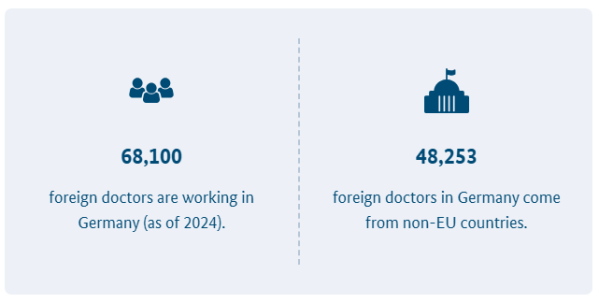 Number of foreign doctors in Germany (Image from make-it-in-germany.com)
Alternatively, many graduates choose to stay in Germany, where demand for doctors is expected to grow significantly by 2030. Fresh graduates can enter the Facharztausbildung (specialisation) or work as assistant doctors, earning monthly salaries between €4,000 and €5,000.
German medical degrees are recognised across the European Union, enabling practice in countries like Sweden and Ireland, both of which face significant healthcare worker shortages that contribute to the broader projected shortfall of approximately 4.1 million healthcare workers across the EU by 2030, according to a European Parliament report.
(The author is Founder and CEO, TERN Group)
link