Evidence-Based Methods for Clinical Skills Teaching : SLU
In 2022, Rafael Nadal approached the baseline and began horizontally abducting his
right arm to loft a tennis ball approximately 5 feet. He abruptly contacted the inferolateral
aspect of the tennis ball with his racquet face, launching it towards his opponent
and landing just proximal to the service line with intense side spin to lead to his
record-breaking 21st grand slam winning point.
Though I described the steps and watched this serve intently, expecting me to subsequently
attempt and then teach this stroke with any level of proficiency from this knowledge
base is not reasonable. Yet, “see one, do one, teach one” has been echoed through
the halls of teaching hospitals for decades, without supporting evidence for its use. Methods for teaching clinical skills in medicine have lagged behind
other industries, even though there are methods for teaching such skills with known validity evidence. Particularly focusing on Peyton’s 4 step approach, this blog post details actionable methods to effective clinical skills-based learning.
The Skills of Medicine
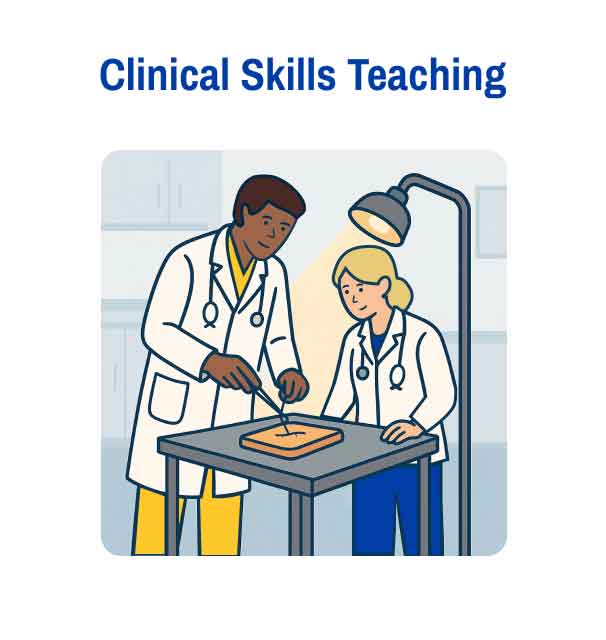
Clinical skills are learned techniques used in medical practice to elicit a certain
result. These skills may be procedural such as line placement, airway establishment,
or joint aspiration, or can be as ubiquitous as physical exam maneuvers. As many trainees
have likely experienced, these clinical skills are not optimally taught through a
lecture format or a passing demonstration.
In the 1960’s, Fitts and Posner posited a skill acquisition theory, outlining three stages of learning: a cognitive stage where the task is intellectualized,
an integrative stage where motor behavior is developed from established knowledge,
and a final autonomous stage. Though this model described the sequence of the learning
process, it did not provide specific guidance on how to lead a learner through these
stages. Many teaching methods share this stepwise approach, though some have since
developed more granular guidance. These methods include Peyton’s 4-step approach to skills teaching, George’s 5-step method for teaching clinical skills, and Sawyer’s 6-step framework for procedural skill teaching; all of which detail teaching methods for skill development
and are described here.
Clinical Teaching Methods
Between Peyton’s four steps, George’s five steps, and Sawyer’s six steps, it may seem
there is a lack of consensus regarding teaching approaches. However, these methods
all share similar principles of initial observation followed by graduated learner
responsibility in their approach to teaching clinical skills.
Peyton’s 4-Step Approach is a graduated method of allowing learners to observe skills
in real time before articulating their understanding of the steps and attempting the
skill themselves. These steps include:
- Demonstration: Instructor demonstrates the skill at normal speed without comments
- Deconstruction: Instructor demonstrates the skill, breaking it into simple steps,
describing each step - Formulation: Instructor demonstrates the skills while the learner describes each step
- Performance: Learner demonstrates the skill and describes each step
George’s 5-Step Approach differs from Peyton’s in its emphasis on the learners initial
contextual understanding. These steps include:
- Overview: Learner must understand how and why the skill is clinically useful
- Demonstrate: Instructor demonstrates the skill without talking
- Repeat: Instructor repeats the procedure but describes each step in detail
- Describe: Learner talks through the steps of the skill
- Preform: Learner performs the skill with the teacher observing and providing feedback
Sawyer’s 6-Step Approach differs from the previous models in its choice not to explicitly
vocalize the individual steps, and in its push to assess learner readiness before
their advancement. These steps include:
- Learn: Acquire knowledge of the procedural skill
- See: Instructor demonstrates the procedure for the learner without commentary
- Practice: Learner deliberately practices with formative feedback
- Prove: Learner competency is assessed in a simulation setting
- Do: Learner performs the procedure in a clinical environment with direct supervision
until the skill can be done independently - Maintain: Regular use of the skill in clinical practice, supplemented by maintenance
training
This sequenced style of procedural learning is supported by evidence. A study utilizing
Peyton’s approach to teaching suturing techniques saw statistically significant improvement across a wide range of skills. Another
compared Peyton’s approach to traditional teaching for gastric tube insertion and found the Peyton group to have shorter times to independent performance and better
patient communication, without an increase in instructional time.
While the learner’s progression in expectations is similar across the above methods,
the learner’s vocalization of procedural steps while still observing the skill appears
to have the greatest impact. This was demonstrated by an analysis comparing the impact of each step in Peyton’s method, which found the third step made the most crucial
contributions to skill acquisition. Although Peyton’s, George’s, and Sawyer’s methods
differ slightly in structure, no particular step count has demonstrated superiority. Which teaching method is chosen is likely less important than the choice to implement
one of these dedicated, sequenced strategies with intentional feedback.
The Utility of Simulation
Medical training can contain innate barriers to implementing this calculated, skill-based teaching. Exposure to certain procedures
can be rare, the hierarchy of medicine can dictate more junior learners are less likely
to have procedural opportunities, and workflow efficiency and the priority of patient
care can diminish chances to practice clinical skills.
Simulation in medical training may combat some of these hurdles. Many have shown the
ability of simulation learning to help achieve performance endpoints, namely improved
speed and safety, in procedures such as endoscopy and surgery. Given the barriers to enacting high-quality procedural teaching methods in everyday
clinical settings, simulation can offer a safe learning environment where a skill
can be repeated in quick succession, as is necessary for many of the aforementioned methods.
Conclusion
The development of clinical skills is an essential piece of medical training that
is best taught through methods outside of traditional classroom teaching. Effective
skills teaching requires a targeted approach with a graduated sequence of learner
participation and autonomy. These methods can be applied broadly, to teach skills
from detailed surgical techniques to proper patient interviewing skills and bedside
communication. Using models such as Peyton’s 4-step approach allows learners to acquire
clinical skills by engaging in a modern, evidence-based learning experience.
 Ryan Plunkett, MD is an internal medicine resident at Saint Louis University School
of Medicine and SSM Health. Plunkett’s areas of professional interest include gastroenterology,
quality improvement, and medical education. Plunkett can be found on X at or contacted via email.
link