First year nursing students’ knowledge, skill levels and learning persistence in nursing practices: a comparison between classical lecture and flipped classroom | BMC Medical Education

Type of study
This is an experimental study with parallel groups. We administered a pre-test, post-test one and persistent test to the participating students.
Ethical consideration
Before we started the study, we obtained written approval from the Karadeniz Technical University faculty’s ethics committee (24 July 2017, Decision No: 457). Written permission was obtained from the Dean’s Office of the Faculty of Health Sciences of a university (23 June 2017) to collect the research data. We carried out the study in accordance with the principles outlined in the Declaration of Helsinki. The participating students gave their written consent indicating that they volunteered to participate in the study after we informed them about the purpose and scope of the study.
Setting and samples
The population of the research covered 185 first-year students enrolled in the NF lesson in the nursing department of the faculty of health sciences of a university in the eastern Black Sea region of Turkey. The period of data collection was between February 2018 -April 2018 and the study was completed in 20 January 2021.
In the power analysis carried out to determine the sample of the research, standard deviation was 1, power value was 98% and margin of error was 0.05. The sample included 66 first-year nursing students, 33 of whom were in the control group, after the power analysis. However, considering the possible dropouts for any reason, the final sample included a total of 74 nursing students, 37 in the experimental and 37 in the control group.
The 37 students in the control group registered for the same lesson for the first time, had unlimited access to the internet, and agreed to participate in the research. Forty-two students who were foreign nationals, did not volunteer, had previous experience with BPM, BGM, DP and NTI practices or did not attend classrooms regularly were excluded from the study. However, two students in the experimental group and one student in the control group were excluded from the study due to absenteeism in the lecture and laboratory applications. The study was carried out with 71 first-year nursing students (35 experimental/36 control).
Data analysis
The data were recorded in the Statistical Package for Social Science 22.00 program by a person other than the researcher. A statistician performed statistical analyses and data reporting. That’s why the person who did the statistical analysis was blinded instead of the researchers and students. The data were analyzed using the SPSS 22 software and frequency, percentage, t-test, chi-square test, Mann Whitney U test, Wilcoxon, and ANOVA tests. The fit of the data to normal distribution was examined with the Kolmogorov Smirnov test. The results were evaluated at a 95% confidence interval and 5% significance level. The statistical significance level was considered p < 0.05.
Development of FCM
Theoretical basis
Constructivism theory, which emphasizes the important role of “situation” and “collaboration” in learning, provides the theoretical basis for the development of the flipped classroom in this study. In traditional lecture classes, adequate practice, assimilation and adaptation of nursing skills may not be possible. Therefore, nursing students may fail to construct the meaning of the knowledge and skills they learn [47, 48]. Constructivism theory argues that learning depends on interaction with others (e.g. teachers, peers and parents) [48]. In a collaborative learning environment, the ideas and thoughts of educators and learners are disseminated in a multi-point and multi-line network, which can encourage the whole learning group to complete the meaning construction of knowledge [48, 49]. Therefore, educators should create a learning environment where students can practice knowledge and skills and organize collaborative learning to help them internalize knowledge and complete meaning construction.
Situational learning design
Literature, cases, lectures, videos and animations shot in the laboratory environment were used to create practical situations. For example, in the pre-lecture exercises, students were asked to shoot videos of errors made while measuring blood pressure, analyze the results, and predict the nursing interventions that should be done to prevent errors. They were asked to interview diabetes nurses in the BSM application and were directed to prepare a video on the subject and analyze it in the classroom.
Collaborative learning design
To design collaborative learning, the researchers used student-centered active learning approaches consistent with the principles of constructivism theory, such as individual (essay discussion, demonstration, skill-building efforts) and teamwork (case study, case discussion, question-answer-discussion, think-pair-share, etc.), where students work in small teams to analyze problems or cases. Before the class, the instructors designed different materials (surprise questions in videos, blood pressure measurement simulator, drug dosage calculation and preparation simulator and many interactive lecture videos, case studies…) that encouraged the students to discover new knowledge, while in the classroom activities, students took different roles as individuals and teams. While the students worked together, the trainers were able to teach the students in the classroom.
Research process
The research process included 3 stages, including preparation, implementation (Figs. 1 and 2) / data collection.
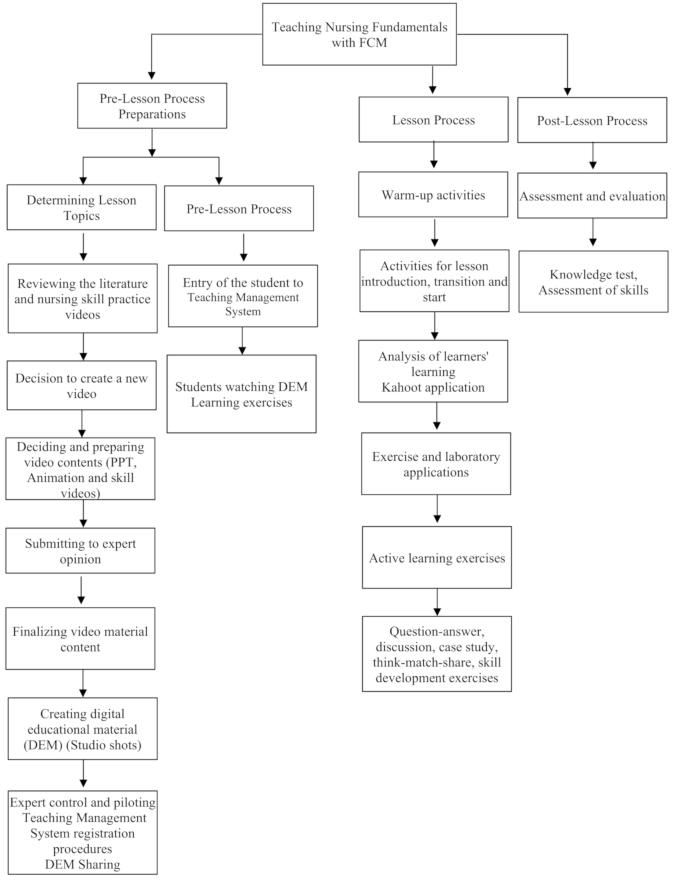
Preparation for and application process of teaching the NF lesson with FCM
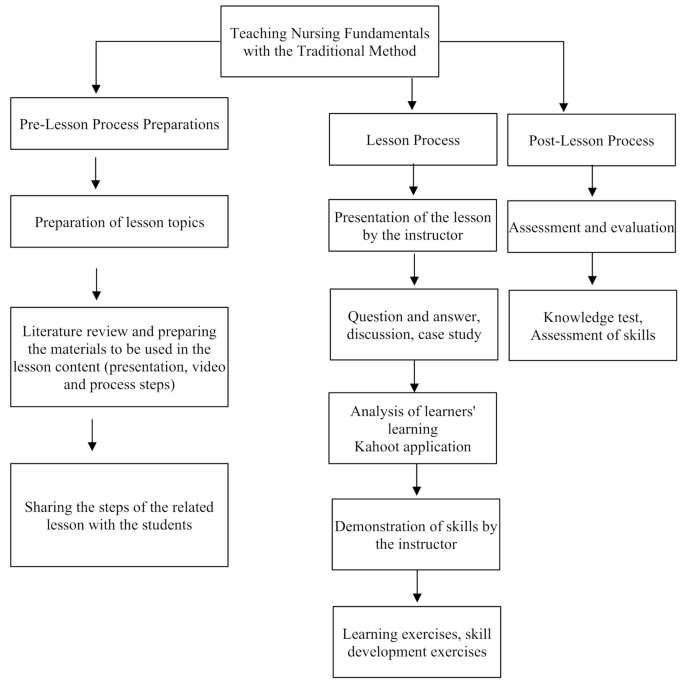
Preparation and application process of teaching the NF lesson with the Traditional Method
Preparation
This stage consists of “Data Collection Tools and Development Process” and “FCM Instructional Materials and Development Process.
Data collection tools and development process
We collected the data with the student information form, knowledge test, BPM, BGM, DP and NTI practices evaluation checklists.
Student Information Form (SIF)
The form includes three questions in which the age, gender, last graduated school and socio-demographic characteristics of the nursing students were questioned by the researcher and 5 questions that determine how students connect to the Internet, how much time they spend on the Internet, whether they want to watch lessons at home and whether they want to take the lessons with technological education methods. The total number of questions in SIF is eight.
Knowledge test
The knowledge test prepared by the researchers based on the literature [50] was used as pretest, posttest and retention test in the study (Supplementary Material Appendix 1). This test aims to measure the level of knowledge of the students on vital signs, nutrition, drug administration and preparation for parenteral drug administration skills, and to determine the persistence of the knowledge. Item difficulty and item discrimination analyzes were made, as a result of which five questions were removed from the 45-item test, and the KR-20 value of the 40-question test was calculated as 0.645 (KR > 60). The time to complete the test is approximately 50 min and each question is worth 2.5 points. Scores from the test range from 0 (lowest) to 100 (highest).
Skill Assessment Forms (SAF)
SAFs are the evaluation forms of the skill practices that the students are expected to perform after the in-class activities to be carried out by the researcher with the students every week. These checklists were developed by researchers based on the literature [50] to assess students’ skill levels regarding Blood Pressure Measurement (BPM), Blood Glucose Measurement (BGM), Drug Preparation (DP), and Nasogastric Tube Insertion (NTI). The checklists contain 37 skill steps for the BPM practice, 35 for the BGM practice, 32 for the DP practice, and 37 for the NTI practice (Supplementary Material Appendix 2). Each skill checklist includes a series of steps scored as 1 (correct) or 0 (incorrect/incomplete/skipped). To ensure comparability across different skills, raw scores were normalized to a 100-point scale using the formula.
(Score Obtained × 100) / Total Possible Score.
Example – Drug Preparation (DP):
|
Total Steps (Max Score) |
Correct Steps (Student Score) |
Final Score Calculation |
Final Score |
|---|---|---|---|
|
32 |
25 |
(25 × 100) / 32 = 78.12 |
78.12 |
This method allowed for consistent evaluation of student performance across different skill sets.
Face validity was established in consultation with peers and experts to ensure that all process steps in the SAFs (BPM, BGM, DP and NTI) practices evaluation checklists are understandable. The coherence of the questions with the purpose of the study, the objectives, and the content of the subject was assured with content validity. To achieve this, three experts in NF and two experts in education assessment and evaluation were consulted, and their opinions were evaluated with the Davis Technique. No question, intervention or item was removed from the forms, but the wording of some questions or procedure steps was improved. The content validity index (CVI) values of all the forms were found to be > 0.80.
FCM instructional materials and development process
FCM teaching material consists of PowerPoint presentations on four topics, two- and three-dimensional animations and videos of basic nursing skills.
Lesson presentations
These presentations were prepared by the researcher using the Microsoft PowerPoint software and includes vital signs, nutrition, drug management and preparation for parenteral drug applications. The prepared presentations were checked for form, color and size in terms of instructional message design.
Animations
They were prepared in computer environment in line with the lesson contents to increase the understanding of the subjects related to vital signs, nutrition, drug administration and preparation for parenteral drug administration skills and to ensure the persistence of knowledge and skills (Supplementary Material Appendix 3).
Videos of basic nursing skills
Videos of basic care skills, which were prepared based on a literature review and included vital signs, nutrition, drug management and preparation for parenteral drug administration, were shot by the researcher in the Nursing Department Nursing Skills Laboratory as practical explanations of all the process steps (Supplementary Material Appendix 4). The videos were prepared as 5 to 15-minute-long videos depending on the content of the skill to be practiced.
Development process of FCM teaching material
In this process, lesson presentations, animations and videos of basic nursing skills prepared for four lessons were combined. Live lesson recording was made in the created virtual studio. While the lesson presentation was being explained, videos shot in the laboratory or related animations were used for the relevant practice skills. PowerPoint presentations were controlled by the researcher, at the beginning of each topic. Students were informed about the objectives related to the topic content, the important parts were emphasized, and the lesson was completed. Some animations were voiced and narrated by the researcher during the virtual studio shooting. Videos shot in the laboratory or related animations were used during lesson presentations. Thus, a lesson video, namely FCM Teaching Material, was created by combining the digital contents prepared (Supplementary Material Appendix 5).
Implementation of flipped classroom
Description of nursing fundamentals lesson
The study was conducted within the scope of the Nursing Principles-II course in the spring semester of the 2017–2018 academic year. Nursing Fundamentals lesson is the first course in which students learn basic nursing knowledge and skills. In addition, students put the knowledge and skills they learn in the classroom and laboratory into practice in the hospital environment for the first time [51, 52]. In this respect, it is very important for student nurses to be in the hospital environment for the first time and to perform some applications for the first time, to perform their applications under supervision and to reinforce the skills they need to learn in laboratories before the hospital experience because it carries a risk in terms of patient safety. In the study, the course was conducted for five weeks with the same total course hours, instructors, textbook and course curriculum, except that the class and time were different for both groups.
Implementing flipped classroom for the experimental group
Lesson topics and homework activities reflecting the study plan of the experimental group were shared from the Teaching Management System (TMS) and WhatsApp group. The first topic to be taught according to the syllabus was made available to students one week before the lesson. The lesson was taught according to FCM. The lesson started with warm-up activities followed by a conversation about the scope of the lesson. Kahoot application. Afterwards, a short summary of the lesson was made and the parts that the students did not understand in the videos were repeated. Unclear parts of the week’s homework activity were explained, and then the students carried out in-class activities as a group/individual under the guidance of the instructor. At the end of the lesson, the application of the relevant nursing skill for measurement and evaluation purposes was evaluated with SAFs (Table 1).
Implementing traditional method for the control group
On the day of the lesson, the lesson was taught with the traditional method in the classroom environment. Lecturing of the lesson was carried out in the form of PowerPoint, demonstration on a model, video demonstration, question-answer and explanation and application of the process steps. Kahoot application was made as an end-of-lesson activity. Surprise questions used in the videos in the experimental group were asked to the control group during the lesson, and the practices made as in-class activities were integrated into the lesson flow. When the theoretical part of the lesson was completed, the instructor of the lesson demonstrated to the students the nursing practice related to BPM, DP, NTI and BGM skills, and explained the steps of the process with their justifications. The students studied the basic skill practice of that week in groups/individually, in the company of the instructor, for 60 min by using the steps related to the application. At the end of the lesson, the application of the relevant nursing skill for measurement-evaluation was evaluated with SAFs (Table 1).
Data collection process (Fig. 3)

In the first week of the spring semester, experimental and control group students were identified and their consent for the study was obtained. The data collection process are three steps.
First step
Implementing SIF /Knowledge pretest
In the second week, both groups applied to SIF and a knowledge test as a pre-test. Within the scope of the study, the teaching of vital signs, nutrition, medication management and preparation for parenteral drug administration was completed in three weeks (second, third and fourth weeks) for the experimental and control groups. During this 3-week period, the lessons of the experimental group students were conducted with FCM, while traditional method was used for the lessons for the control group.
First follow-up: determination of first Follow-up scores of basic nursing practices
While the experimental group students were practicing the skill of the relevant week, the instructor observed the students one by one to determine the “First Follow-up” score and evaluated them with the SAF of the relevant practice skill. This evaluation was completed in three weeks in a way to evaluate one practice each week in total for BPM, DP, NTI and BGM.
In the study, the “first follow-up” scores of the BPM and DP subjects for the control group were determined on the day of the course by the instructor of the course, firstly, the relevant skill was demonstrated by the instructor of the course, and then each student repeated the nursing practice until they learned the process steps with their justifications. After the teaching of the relevant application was completed in the laboratory, the “First Follow-up” scores of the students in the control group were determined by the expert instructor determined for the study in the field of Nursing Principles. NTI and BGM practices were evaluated during the laboratory practices.
Second step
Implementing knowledge post test
After the first follow-up score of the four skills within the scope of the subject was determined, at the end of the fourth week, a knowledge test to measure the theoretical knowledge of both groups was applied as a post-test.
Persistence follow-up: determination of persistence scores of basic nursing practices
In order to determine the skill persistence of the experimental group, BPM, DP, NTI and BGM skills were evaluated by the expert lecturer determined for the study in the field of Nursing Principles for the four application skills within the scope of the subject during the 4-week laboratory practice. Persistence Follow-up scores were determined by the same experts using the evaluation forms. The experimental group students were not included in the training on NTI and BGM skills in the laboratory application program and only persistence follow-ups were conducted.
In the control group, persistence follow-ups of BPM and DP practices were conducted. After the observations, feedback was given to the student for the incorrect steps, and it was ensured that he/she repeated the applications until he/she learned them. NTI and BGM applications were taught to the students during the laboratory process. Therefore, skill persistence in these subjects was not evaluated after the laboratory process, and the measurement was recorded as the first follow-up.
Last step
Implementing knowledge persistence test
After the end of the laboratory application (4 weeks after the post-test), a knowledge test was applied to the experimental and control groups to determine the retention of the theoretical knowledge, and the “Knowledge Persistence Test” scores were determined.
link