From classroom to workplace: how entrepreneurship education influences university students’ employability
Theoretical background
Social Cognitive Career Theory (SCCT)
SCCT, initially proposed by Bandura and further developed by Lent, Brown, and Hackett, provides a robust, multidimensional framework for understanding individual career decision-making and development (Lent et al., 1994; Lent et al., 2000). SCCT emphasizes the dynamic interaction between environmental factors, personal attributes, and observable behaviors in shaping career trajectories, encapsulated within its triadic reciprocal model (Lent and Brown, 2019; Adebusuyi et al., 2022).
In the context of entrepreneurship education, SCCT serves as a compelling theoretical lens for examining how educational experiences influence employability. For instance, innovative curriculum designs, teacher professionalism, opportunities for participation in competitive events, and hands-on practical experiences emerge as critical factors for enhancing both educational quality and student capabilities. These align well with SCCT’s focus on the impact of learning experiences and perceived self-efficacy on career outcomes (Lent et al., 2002). Liu et al. (2024b) supports that self-efficacy can be used to predict the graduates’ employability. Importantly, Cui and Gu (2024) further validate this perspective, highlighting the pivotal role of entrepreneurship education in shaping students’ career aspirations and enhancing their employability in competitive labor markets. While SCCT’s theoretical adaptability and prior applications in related studies (e.g., Gunawan et al., 2024) make it a powerful framework, the paper could benefit from a deeper exploration of its specific relevance to employability in entrepreneurship education. For example, it would be helpful for future research to elaborate on how SCCT uniquely accounts for the dynamic interplay between educational environments and career decision-making processes in entrepreneurial contexts.
Tinto’s model of student retention
Vincent Tinto’s Model of Student Retention, emphasizing students’ academic and social integration, is widely recognized in higher education research for explaining and predicting student retention and attrition phenomena (Tinto, 1975; Tinto, 1993). According to Tinto’s theory, successful student retention must facilitate integration within both academic and social communities, as these elements are crucial for students’ overall engagement and persistence in higher education (Chrysikos et al., 2017). In other words, dual integration mechanisms, including academic engagement with faculty or courses and social connections with peer networks, establish key premises for persistent decision making and overall student development.
Formal academic integration and informal social integration have important implications for the development of student competence (Chrysikos et al., 2017). Formal academic integration involves curriculum design, faculty interaction, and institutional support, while informal social integration includes peer networks, extracurricular activities, competition activities and institutional policies that support student belongingness (Tight, 2020). Therefore, entrepreneurship education conforms to Tinto’s theoretical framework, while promoting the academic and social integration of students. Academically, entrepreneurship courses enhances students’ employability by providing theoretical knowledge and practical skills, fostering opportunity recognition, innovative thinking, and business acumen (Fayolle and Gailly, 2008; Nabi et al., 2017). Through structured coursework, mentorship, and hands-on experiences from entrepreneurial professions, students develop the competencies required for success in dynamic job markets. Socially, entrepreneurship policies integrate entrepreneurial resources by providing entrepreneurial capital or subsidies, entrepreneurial technical guidance and skills training, promotes the formation of entrepreneurial network, and forms a benign two-way interaction with social integration. Moreover, entrepreneurial networks, incubators, and startup competitions provide platforms for students to connect with peers, mentors, and industry professionals. For example, team-based projects, business simulations, and entrepreneurship competitions enhance critical soft skills such as communication, leadership, and teamwork, which are essential for both academic success and career readiness (Pittaway and Cope, 2007).
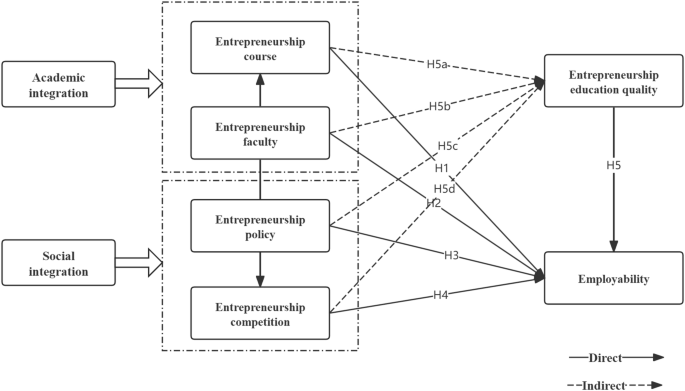
Therefore, by incorporating Tinto’s student integration theory into the Employability Conceptual Model (See Fig. 1), this study highlights the dual role of entrepreneurship education in fostering both academic and social integration. Higher education institutions aiming to enhance student retention and career preparedness should adopt strategies that integrate entrepreneurship education within broader academic and social support structures.
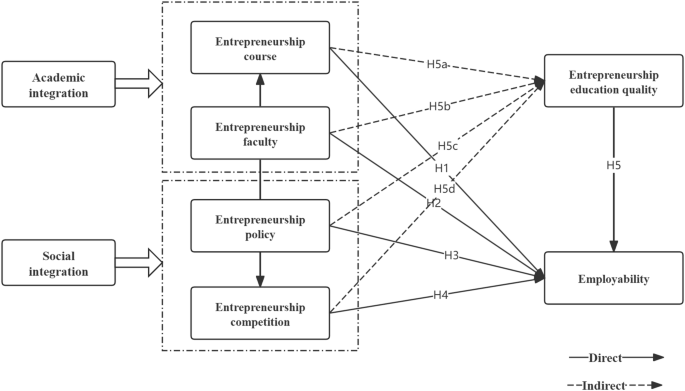
Employability Conceptual Model.
Research hypotheses
Employability
Research indicates that the relationship between graduates’ employability and career development is a significant topic in educational research, garnering attention from educators and policymakers (Dai and Pham, 2024). According to Fugate et al. (2004) concept, employability encompasses dimensions such as professional identity, adaptability, social capital, and human capital, with adaptability and flexibility being core characteristics (Santos, 2020). Developing career adaptability significantly enhances graduates’ competitiveness (Ma et al., 2024), while having a forward-thinking mindset enables individuals to anticipate and adapt to the ever-changing work environment and acquire new skills (Tymon, 2013). This ability not only aids individuals in achieving success in the labor market but also positively impacts the competitiveness of organizations (De Vos et al., 2011). Based on theoretical and empirical research, this article conceptualizes student employability into four core dimensions: forward-thinking, career adaptability, flexibility, and execution. Forward-thinking is the ability to understand the future career development prospects. Career adaptability is the ability to understand the work procedures of future careers. Flexibility is the willingness and ability to I understand the mobility of future careers. Execution is the practical application of skills and knowledge in real-world settings, such as the ability to explore career paths and to have goal-oriented action capabilities.
Entrepreneurship courses
The number of global entrepreneurship courses and programs has rapidly increased (Eesley and Lee, 2021), aligning with higher education’s goal of cultivating key skills for students’ career success (Collet et al., 2015). Employability refers to an individual’s ability to obtain and maintain employment in the labor market, including professional skills, personal qualities, social abilities, and job-seeking strategies (Cheng et al., 2022). Although the core objective of entrepreneurship courses is not directly aimed at enhancing employability, research shows a close relationship between the two (Duval-Couetil, 2013). Entrepreneurship courses enhance key components of employability by strengthening students’ adaptability, innovativeness, and risk-taking abilities (Fayolle and Gailly, 2015). For the purpose of this study, entrepreneurship courses refer specifically to those designed to develop entrepreneurial skills and mindset (e.g., opportunity identification, business model development), as opposed to general business courses that focus on broader management, finance, or marketing concepts. Therefore, this paper proposes the following research hypothesis:
Hypothesis 1. Entrepreneurship courses have a positive impact on enhancing students’ employability.
Entrepreneurship faculty
The expertise and teaching experience of entrepreneurship faculty are pivotal in enhancing the employability of students. The shift in academic teaching from traditional lecture-based methods to approaches emphasizing educators’ practical experiences and entrepreneurial insights has been a defining trend in entrepreneurship education (Ozen et al., 2023). This shift reflects the increasing importance of faculty who bring both academic rigor and real-world entrepreneurial expertise to the classroom. Effective entrepreneurship educators not only impart theoretical knowledge but also design and implement experiential learning activities, such as case analysis, business simulations, and opportunity identification exercises. These teaching methods have been shown to significantly enhance critical workplace skills such as problem-solving and decision-making (Pardo-Garcia and Barac, (2020)). Moreover, empirical research highlights the importance of faculty experience in shaping effective entrepreneurship education. For example, Liu et al. (2024a), in the context of Chinese higher education, demonstrated that faculty members with entrepreneurial backgrounds are better equipped to foster student engagement and skill development. Further distinguishing entrepreneurship faculty from instructors in general business disciplines are their industry connections and professional backgrounds. These connections provide students with unique networking opportunities and exposure to real-world entrepreneurial challenges, thereby bridging the gap between classroom learning and practical application. Such faculty-driven interventions play a critical role in equipping students with the skills needed to thrive in the labor market, whether they pursue entrepreneurial ventures or traditional career paths. Therefore, this paper proposes the following research hypothesis:
Hypothesis 2. Entrepreneurship faculty has a positive impact on enhancing students’ employability.
Entrepreneurship policies
Higher education institutions play a key role in students’ transition from school to the workplace, contributing to social and economic development by providing resources and support (Petruzziello et al. (2022)). Individual beliefs, values, and attitudes are influenced by the socio-cultural environment, which in turn affects behavioral patterns. In recent years, a growing body of research has explored the interplay between higher education and employability (Gazi et al., 2024). At the institutional level, higher educational institution provides entrepreneurship funding subsidies, entrepreneurship technical guidance and entrepreneurship courses or entrepreneurial skills training. These institutional policies form an interconnected framework that supports entrepreneurship education through multiple channels, including resource allocation, curriculum development, and industry training. For example, Dahlstrand and Stevenson, (2010) mentioned that entrepreneurship policies at the university level can better promote entrepreneurship culture by creating an environment and support system, including promoting entrepreneurship, entrepreneurship education and startup support, to expose more students to entrepreneurship in the education system, and to remove barriers to entrepreneurship in specific target groups. Among various approaches, Costa et al. (2017) finds that entrepreneurship education and training have emerged as particularly effective strategies for stimulating entrepreneurial intentions and enhancing career prospects. In the context of increasing job market challenges, fostering students’ entrepreneurial inclinations has become a viable solution to address poor employment prospects (Martínez-Cañas et al., 2023). By equipping students with essential knowledge, skills, and practical experiences, universities play a pivotal role in increasing their adaptability to market dynamics and improving their employability. Therefore, this paper proposes the following research hypothesis:
Hypothesis 3. Entrepreneurship policies have a positive impact on enhancing students’ employability.
Entrepreneurship Competitions
Entrepreneurship competitions, as an important practical component of entrepreneurship education, are widely recognized as an effective way to cultivate students’ entrepreneurial spirit and employability. Through participation in competitions, students can apply classroom theory to practical business problems, enhance operational skills, and develop key competencies such as innovative thinking, teamwork, leadership, and stress management in a competitive environment (Bodolica and Spraggon, 2021). Abichandani et al. (2022) points out that competitions are effective platforms for stimulating student innovation and creativity. Additionally, competitions provide students with opportunities to interact with industry experts and potential employers, broadening their career perspectives and benefiting future employment (Watson and McGowan, 2020). In competitions, time and resource constraints force students to complete tasks under high pressure, thereby enhancing their leadership and stress management abilities (Nabi et al., 2017). Therefore, this paper proposes the following research hypothesis:
Hypothesis 4. Entrepreneurship competitions have a positive impact on enhancing students’ employability.
Entrepreneurship education quality and its mediating role
The quality of higher education is a common concern for multiple stakeholders. As education becomes more widespread, expectations for quality continue to rise (Tight, 2020). Entrepreneurship education aims to cultivate students’ ability to seize opportunities and take action (Tiberius and Weyland, 2024). Given the increasing emphasis on measuring entrepreneurship education outcomes (Wong and Chan, 2022), it is crucial to determine the impact of education on students’ skill accumulation. The quality of entrepreneurship education has become a key indicator for assessing educational effectiveness (Kinash et al., 2017), directly influencing whether students can apply what they have learned in practice. Implementing authentic and challenging assessment methods is essential for improving educational quality. Such assessments not only test knowledge and skills but also promote the development of professional attributes, enhancing graduate employability (Ashford-Rowe et al., 2013). Therefore, this paper proposes the following research hypothesis:
Hypothesis 5. The entrepreneurship education quality has a positive impact on enhancing student employability.
Numerous scholars have explored the impact of entrepreneurship education on employability, emphasizing factors such as course design, faculty expertise, competitions, and practical experiences. Based on Model of Student Retention, this paper regards curriculum and faculty as academic integration, while competition and policy as social integration. Jones et al. (2017) found that the curriculum design, innovative teaching methods, and practical effectiveness of entrepreneurship education are positively correlated with student employability. Similarly, Liu et al. (2025) confirmed that more learning resources and less learning needs contribute to students’ perceived employability in entrepreneurship courses. A survey of 154 undergraduate and graduate students from a private university in Bangladesh further supports the mediating role of educational quality (Hasan et al., 2024). Their research shows that educational quality is able to mediate the relationship between the courses and students’ employability. High-quality education amplifies the positive impact of the curriculum on employability by adjusting the input of curriculum resources.
Hypothesis 5a. Entrepreneurship courses indirectly positively influence employability through the quality of entrepreneurship education.
Teachers’ professional knowledge, experience, and guidance abilities significantly impact students’ entrepreneurial learning outcomes (Solomon, 2007). Educational quality is also reflected in curriculum design, teaching methods, assessment systems, and learning resources (Harvey and Green, 1993). Entrepreneurship education enhances students’ employability by improving innovative thinking, problem-solving, and teamwork skills (Fayolle and Gailly, 2015). The quality of education is regarded as an important bridge between teachers and employability. On the one hand, teachers’ professional level and teaching methods affect the quality of education (Akareem and Hossain 2016). High-quality entrepreneurship education usually includes the organic combination of theoretical knowledge and practical skills, which can help students apply what they have learned in simulated real business situations, so as to better understand market dynamics and entrepreneurial risks. On the other hand, the research of Rae, (2007) shows that high-quality entrepreneurship education can significantly improve students’ entrepreneurial intentions, but also provide them with more diversified career path choices, which indirectly promote their employability (Costa et al., 2017; Ashford-Rowe et al., 2013).
Hypothesis 5b. Entrepreneurship faculty indirectly positively influence employability through the quality of entrepreneurship education.
The influence of entrepreneurship policies, as macro-level interventions, on the quality of entrepreneurship education has been recognized. Rasmussen and Sørheim, (2006) noted that government policies enhance entrepreneurship education quality through financial support, standard-setting, and promoting industry-academia collaboration. Fayolle and Gailly, (2008) emphasized the importance of policies in shaping educational content and methods. Nabi et al. (2017) found that regions with supportive entrepreneurship policies have higher quality entrepreneurship education in universities, correspondingly improving graduate employability. Furthermore, the empirical study by Hasan et al. (2024) confirmed that the connection between policy, quality of education and employability can be conceptualized as an indirect pathway. For instance, policy initiatives only translated into better employment outcomes when they successfully enhanced the quality of entrepreneurship education programs. This indirect relationship highlights the crucial mediating role of education quality in converting policy interventions into tangible employability benefits.
Hypothesis 5c. Entrepreneurship policies indirectly positively influence employability through the quality of entrepreneurship education.
Bodolica and Spraggon, (2021) points out that participating in entrepreneurial projects and competitions can effectively stimulate practical skills and risk-taking. Specifically, practical activities such as entrepreneurship competitions can enhance students’ self-efficacy and enhance their risk management and problem solving skills, which are the key components of employability (Fearon et al., 2019). Therefore, entrepreneurship competitions can directly promote the improvement of employability. In addition, entrepreneurship competitions can also indirectly enhance students’ employment competitiveness by optimizing the quality of entrepreneurship education. Specifically, Li et al. (2023) found that the entrepreneurship competition provides a real practical scenario for entrepreneurship education and helps to transform theoretical knowledge into practical skills. Through the competition, teachers can better understand the students’ learning needs, so as to optimize the teaching content and methods, and improve the quality of education. High-quality entrepreneurship education, in turn, can cultivate students’ entrepreneurial thinking and vocational skills, and ultimately enhance their competitiveness in employment (Killingberg et al., 2021).
Hypothesis 5d. Entrepreneurship competitions indirectly positively influence employability through the quality of entrepreneurship education.
link