Inculcating learner autonomy (LA) in a technical English course using OASIS3: a 5-stage model
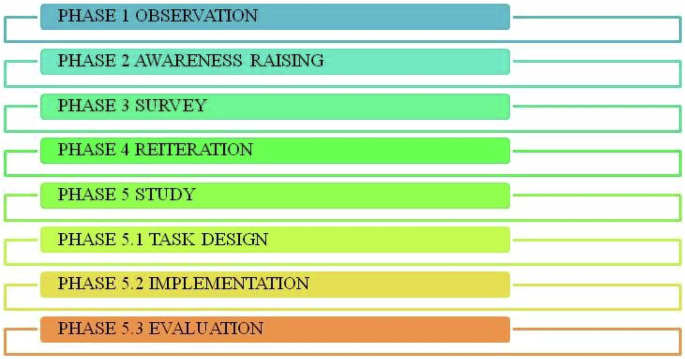
Autonomous learning refers to the process in which learners take the initiative to set learning goals, develop learning plans, select appropriate strategies, monitor their progress, and evaluate outcomes (Yuping and Tong 2010). By introducing the concept of LA and educating students on their responsibilities as autonomous learners, this research aims to integrate LA into Indian engineering classrooms, fostering self-reliance among students. This section examines the strategies, models, and practices previously utilised to implement LA effectively in classrooms.
Defining learner autonomy
Holec (1981) introduced the term LA to describe the ability to take control of one’s own learning. According to Holec, learners can acquire this ability either naturally or through formal education, but it requires methodical and deliberate effort. Holec (1981) identified essential responsibilities of autonomous learners, which include “determining the objectives; defining the contents and progressions; selecting methods and techniques to be used; monitoring the procedure of acquisition (rhythm, time, place, etc.); and evaluating what has been acquired” (Holec 1981, p. 3). Key concepts, such as “responsibility” and “decision-making,” are fundamental to these responsibilities. Researchers such as Dam (1990), Little (1991), Dickinson (1992), and Benson et al. (2001) have added to Holec’s definition of autonomy by looking at aspects such as curriculum development, psychological aspects, critical evaluation, and the achievement of autonomy.
To foster LA, participants must develop a sense of accountability and actively engage in decisions related to their learning (Jose et al. 2020). This research focused on integrating LA principles into the Technical English course of a first-year engineering programme. Thus, a learning environment in which learners can decide what, when, where, and how they wish to learn within a learner-centred classroom is needed. Schmuck and Schmuck (1978) provided one of the earliest definitions of the learning environment, describing it as the context in which learners and teachers interact. A conducive learning environment considers various factors, such as interpersonal relationships, the emotional and structural elements of teaching style, classroom organisation, teacher expectations, attitudes towards learners, levels of teacher control, disciplinary considerations, and the gender and age of the learners (Gülderen and Pinar 2013). In learner-centred classrooms, students accept responsibility for their education, guided by teachers, who act as facilitators. This model is supported by the concepts of “freedom of choice” and collaborative learning, which further enhances the development of LA.
Approaches to inculcate LA
Many studies have explored various approaches to fostering LA in classroom environments. Holec (1981) asserts that learners must fulfil two essential conditions to achieve autonomous learning. First, learners must possess the ability to take charge of their own education; second, an instructional framework must be in place to actively support and nurture this autonomy. Learners have the ability and responsibility to complete tasks, but they will not do so without motivation. Autonomous learners can set learning goals, define course objectives and progressions, select appropriate methods and strategies, track their learning process, and evaluate their progress (Schmuck and Schmuck 1978).
Nunan (1997) proposed a nine-step programme for training learners to promote LA (see Table 1). Learners can follow these steps sequentially or overlap them to transition from complete dependence on the teacher to achieving autonomy. This model serves as a guide for enabling LA within classrooms. Little (1991) argued that three guiding principles should be employed to create an independent classroom: learner participation, learner reflection, and the use of the target language. To nurture LA, he recommends the use of European Language Portfolio as a self-reflective tool in the classroom, with logbooks and diaries for tracking learners’ development. This approach allows learners to set realistic and achievable goals, select suitable methods and procedures, and gain a deeper awareness of their level of autonomy. By encouraging self-monitoring and assessment, this strategy enhances learners’ self-awareness (Little 1991).
Kennedy (2007), in his self-determination theory, asserted that the most effective ways to foster autonomy are to remove external controls and to provide learners with the freedom to make choices. Thus, in addition to developing self-awareness, introducing the concept of “freedom of choice” can increase learners’ motivation. The novelty of having freedom in their learning encourages active participation in class. In a traditional classroom, the teacher instructs learners on how to complete a task. In an autonomous classroom, learners attempt to complete tasks independently. Learners determine whom to approach for assistance—whether peers or teachers—and specify the type of help they require. This fundamental shift from “asking me to learn” to “I want to learn,” from “having learned” to “knowing how to learn,” and from “passive reception” to “active reception” epitomises the essence of autonomous learning (Guang & Xiao-Hua, 2009). This innovative learning approach enables learners to acquire skills and knowledge through comprehension, investigation, and decision-making (Ryan and Deci 2000). As learners align their actions with their beliefs and goals, they engage more actively in their learning and demonstrate greater interest in the subject matter (Yuping and Tong 2010).
Vygotsky (1978) highlighted that “individuals are active participants in their knowledge,” which reinforces the significance of LA, where learners take responsibility for their learning. They also suggested that “the nature of learning is inherently collaborative,” which aligns with the goals of this study. On the basis of Vygotsky’s theories, this research aims to use collaborative tasks to foster LA among learners. Dam (2011) also emphasised the role of peer learning in implementing LA. She asserts that teachers must create awareness among learners regarding their learning objectives. Instructors can encourage peer learning by assigning group tasks and monitoring learners’ progress using self-reflective tools. This study also draws on Kolb’s (1984) experiential learning theory, which proposes that learners acquire knowledge through direct experience. In this framework, learners engage in new experiences, reflect on their actions, conceptualise them on the basis of these reflections, and apply their learning. This study further explores several of Kolb’s processes of experiential learning.
Models for improving learner autonomy
This study aims to instil two core principles of LA within the English course. Various models have been developed to promote LA, and a selection of these models is discussed in this section.
Nunan’s model focuses on three key stages: the initial awareness level, the dependent level, and the final transcendental level. In the awareness stage, learners are “made aware of the pedagogical goals and the content of the materials.” At the dependent level, learners engage with support from teachers and peers. Once they reach the transcendental level, learners are capable of performing independently and creatively (Nunan 1988). Similarly, Scharle and Szabo (2000) present a three-phase paradigm that involves raising awareness, changing attitudes, and transferring roles in their book The Development of Autonomy. Benson’s model of LA divides control over language teaching and learning processes into three primary categories: learning management, cognitive processing, and learning content (Benson 2013).
In terms of learner evaluation, Tassinari (2012) developed a dynamic autonomy model consisting of three dimensions: action, cognition, metacognition, and affective aspects. The final social dimension integrates these three areas through cooperation. In their study, Tassinari investigated the action-oriented dimension of LA, integrating key principles such as planning, selecting materials and methods, completing tasks, monitoring progress, evaluating outcomes, and collaborating with and managing learning. The self-reflective phase explores the affective dimension, focusing on learners’ emotions and motivation. Tassinari (2012) contended that learners who achieve LA are not driven solely by the pursuit of perfect scores; rather, each learner makes decisions informed by their needs, priorities, attitudes, and personal experiences. The emphasis on LA lies more in the learning process than in the final grades.
Teachers’ role in LA
In recent decades, educators have placed significant emphasis on LA, incorporating it into institutional missions and vision statements. Teachers, as the primary architects of the learning environment in educational settings, play a critical role in supporting learners’ autonomy. Their involvement is essential for fostering the autonomous behaviours that learners demonstrate (Reeve and Jang 2006; Borg and Alshumaimeri 2019; Young-Jones et al. 2019). While the capacity for autonomy may not always be innate and cannot be taught directly, it can be mediated through the right support (Tan and Chan 1998). Teachers who promote LA foster an internal locus of causality and a sense of agency by empowering students to act on the basis of their preferences and make informed choices (Niemiec and Ryan 2009; Reeve 2009). By providing choices, teachers enable learners to make informed decisions about their education while helping them identify and pursue their interests and needs. This, in turn, plays a significant role in facilitating autonomy (Reeve and Jang 2006; Basri 2020).
Palfreyman and Benson (2019) argued that “the role of the teacher is to carefully and responsively scaffold attempts by the learner to take control of their learning decisions and performance in the second language” (Palfreyman and Benson 2019, p. 672). Thus, teachers must take a leading role in assisting learners with processes such as goal-setting, training, self-evaluation, observation, and assessment related to language learning. The roles that teachers play in an autonomous learning environment can be categorised primarily as follows: (a) “facilitators”—those who act as psychosocial providers, technical workers, motivators, and guides to help learners overcome obstacles; (b) “directors and organisers”—those who plan various activities and games that align with learners’ interests and expectations; and (c) “counsellors”—those who alleviate learners’ anxieties by offering advice on how to meet learning outcomes (Palfreyman and Benson 2019). Camilleri (1997) proposed three roles for teachers in autonomous learning: managers, resource persons, and counsellors. In their role as managers, teachers help learners map out their learning paths. As resource persons, they offer a variety of strategies and alternatives to enhance learning. Finally, as counsellors, teachers are sensitive to learners’ emotional states and offer timely support to address affective factors. These findings highlight the importance of teachers in fostering responsibility among learners and supporting them throughout the learning process.
Zero–approach teaching mode (ZATM)
In the context of LA, educators do not employ traditional teaching methods in the classroom. Instead, teachers assume various roles, including facilitators, mentors, and guides. Tian’s (2008) “Zero Approach Teaching” model creates an autonomous learning environment. Earlier methods, such as the learner-centred approach, focused primarily on learners and their learning processes. However, Tian’s zero approach teaching model (ZATM) places greater emphasis on the roles of teachers than those of learners. In this learner-centric approach, how to teach takes precedence over how to learn. This focus is more suited to fostering LA, as it is essential for teachers to understand how to instil LA among their students (Tian 2008). As Tian (2009) stated, “In actual teaching and learning, learners are active explorers, and the role of teachers is to set up the context for problem-solving, evoke learners’ interest in learning, satisfy their cognitive needs, and stimulate the motivation for autonomous exploration of knowledge, rather than merely passing on or imparting existing knowledge.”
In the zero-approach teaching model, the role of teachers extends beyond the traditional function of knowledge-givers. Teachers act as facilitators who create engaging learning environments that encourage independent exploration. They are responsible for assigning learning materials, monitoring learners’ progress, providing diverse learning methods, and overseeing the entire learning process. Learners, on the basis of the options provided by the teacher, have the autonomy to select their own learning materials, set their own pace, and track their progress (Tian 2008). This autonomy enables learners to discover facts, understand concepts, and engage in self-directed learning. In an effort to inculcate LA principles in the “Technical English” engineering classroom, this research adopts the zero approach teaching model. In this study, teachers do not instruct students on the selected topics in the traditional manner. Instead, they provide learners with the freedom to choose their learning activities from a list of options. Drawing from zero approach teaching mode, teachers act as facilitators in the learning environment, offer access to resources, negotiate deadlines, provide guidance for tasks, monitor the learning process, and evaluate student work according to previously discussed rubrics.
link