Reform and innovation of physical education teaching methods in universities based on fuzzy decision support systems
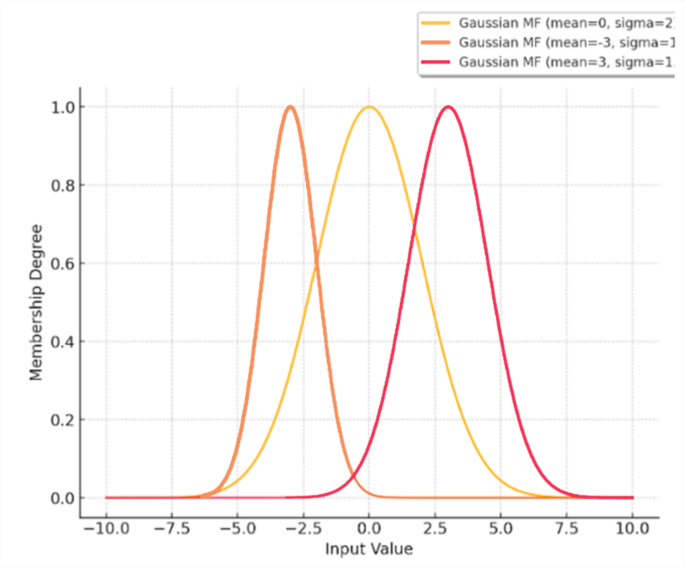
To ensure the validity of the efficiency of the suggested ATAM framework, experiments were performed on actual physical education data sets. Performance was evaluated based on several factors, such as evaluation rate, recommendation quality, classification accuracy, evaluation time, and output combination rate, with baselines. The suggested work’s Fuzzy Decision Support System (FDSS) evaluates and optimizes PE teaching techniques using fuzzy logic. In this scenario, the FDSS would function as follows:
Information gathering
Student academic achievement, physiological characteristics, fitness levels, recovery rates, injury history, and physical education session durations are among the input data that the FDSS collects. Because of their intrinsic imprecision or uncertainty, these inputs are well-suited for fuzzy logic analysis. This work introduces the fuzzy model to reform and innovates physical education teaching methods associated with efficiency and performance. In this case, the assuming value ranges from 0 to 1, and the fuzzy model was chosen. The fuzzy is used to develop the boundary values associated with the fuzzification method, which includes the training phase and goal setting among the students. The following Eq. (5) is used for the fuzzification approach for the different performance levels among the students.
$$\:_=\left(_+\frac{1}{{u}_{n}}\right)*\prod_{{g}_{0}}\left(I+{f}_{v}\right)*\left(\frac{{m}_{e}+{a}_{d}}{{c}_{i}+{u}_{0}}\right)+\left(\frac{\raisebox{1ex}{${l}_{t}$}\!\left/\:\!\raisebox{-1ex}{${r}^{{\prime\:}}+{\Delta\:}$}\right.}{{\sum}_{{m}^{{\prime\:}}}\left({q}_{i}+{h}_{y}\right)}\right)*{a}_{d}.$$
(5)
The fuzzification is obtained by equating the above Eq. (5), and it is described as \(\:\:{z}_{c}\). Inclusive practice and professional development are considered and provide efficient processing. Here, the mapping is observed between the current and previous state of the method and estimates the time and academic, and they are labeled as \(\:\:{m}_{e}\:and\:{a}_{d}\), the goal setting is symbolized as \(\:\:{g}_{0}\). The constraints are observed in this work, and it is represented as \(\:\:{c}_{i}\). The classification is executed in this case for the quality improvement in PE, and it is represented as \(\:\:\left(\frac{\raisebox{1ex}{${l}_{t}$}\!\left/\:\!\raisebox{-1ex}{${r}^{{\prime\:}}+{\Delta\:}$}\right.}{{\sum\:}_{{m}^{{\prime\:}}}\left({q}_{i}+{h}_{y}\right)}\right)\). The fuzzification is observed in this case by examining the better mapping among the previous state of processing, and the value determination is followed up. The accessibility is observed in this case and determines the goal setting for the student. This method’s membership function is designed assuming the value ranges from 0 to 1. Thus, the fuzzification results in the membership function that identifies the assessment level for the student. From this membership, the function is executed in this fuzzy model.
$$\:\text{m}\left({\text{t}}_{\text{c}}\right)\text{=}\left\{{\text{s}}_{\text{i}}\text{,}{\text{h}}_{\text{m}}\left({\text{s}}_{\text{i}}\right)\text{*}\left(\frac{{\text{g}}_{\text{0}}\text{+}{\text{t}}^{{\prime\:}}}{{\text{r}}^{{\prime\:}}\text{+}{\text{q}}_{\text{i}}}\right)\text{|}{\text{s}}_{\text{i}}\in \varnothing \right\}.$$
(6)
The membership function provides efficiency and performance-related improvement in this work. The assuming value in the range [0, 1] is described as \(\:\:m\left({t}_{c}\right)\)where the teaching is used to assume values in the membership function. The universal of information states that the session is taken for the levels of students to guide improvement. The membership function is represented as \(\:\:{h}_{m}\). The defined set of ordered pairs is the deviation factor labeled as \(\:\:{\varnothing}\). Thus, the membership is formulated in Eq. (6), providing reliable processing for time and constraints.
The FDSS creates fuzzy membership functions for every input component. A few examples of the kinds of states or degrees of performance that these functions may transfer into fuzzy sets include “high fitness,” “moderate recovery,” and “low academic performance.” Instead of giving each input a hard and fast binary value, the system may represent the extent to which it belongs to these fuzzy sets using the membership functions. Figure 6 presents the fuzzy process illustration.

Fuzzy process illustration using \(\:\:m\left({t}_{c}\right)\)
Fuzzy inference
To assess the interrelationships of the input variables, the FDSS evaluates the membership functions according to a set of fuzzy rules. A rule may specify, for instance, that a “moderate intensity” training program is suggested for students with a “high fitness level” and a “moderate recovery rate.” For the system to make more accurate and versatile judgments, these rules deal with the imprecision and overlap between various parameters.
The fuzzy process is performed for \(\:\:{t}_{o}\in\:\alpha\:\left(\eta\:\right)\)and \(\:\:\alpha\:\left(\rho\:\right)\)for \(\:\:{z}_{c}\)using \(\:\:{c}_{i}\). This \(\:\:{c}_{i}\) impacts the \(\:\:{z}_{c}\) process using \(\:\:m\left({t}_{c}\right)\in\:\alpha\:\left(\rho\:\right)\)and \(\:\:\alpha\:\left(\eta\:\right)\) for \(\:\:\alpha\:\left(\eta\:\right)\)for \(\:\:{\Delta\:}\)such that \(\:\:\varphi\:\)is the extractable output. In this case \(\:\:({z}_{c}\: \oplus {m}_{e})\) and \(\:\:\left({z}_{c} \oplus {a}_{d}\right)\) are the feasible combinations to suppress \(\:\:{c}_{i}\) in all \(\:\:{t}_{o}\). Depending on the \(\:\:{l}_{t}\)and\(\:\:{d}_{i}\) due to the \(\:\:{C}_{i}\) impact, the \(\:\:{z}_{c}\)is performed across \(\:\:\varDelta\:\). This extraction is validated for studying the impact over \(\:\:\alpha\:\left(\eta\:\right)\) and \(\:\:\eta\:\left(\rho\:\right)\)and thus, the analysis \(\:\:\left(with\:{c}_{i}\right)\) is presented in Fig. 6.
The constraints \(\:\:\left({m}_{e}\:and\:{a}_{d}\right)\)impact the performance and efficiency factors for different methods (grades). This is due to \(\:\:m\left({t}_{c}\right)\) that identifies at least one \(\:\:\varphi\:\) in any of the \(\:\:{l}_{o}\). The \(\:\:{d}_{i}\) and \(\:\:{l}_{t}\) imbalance results in the \(\:\:{t}_{o}\)evaluation between successive grades. Therefore \(\:\:\left({z}_{c} \oplus {m}_{e}\right)\) and \(\:\:\left({z}_{c} \oplus {a}_{d}\right)\)are responsible for \(\:\:{\Delta\:}\) across best and least-fit solutions. If the best-fit solution before and after \(\:\:{c}_{i}\) this particular Δ is retained for recommendation with the current monitored session. The alternating \(\:\:m\left({t}_{c}\right)\) is constructed based on \(\:\:I\) and its reachability to \(\:\:{s}_{i}\) and \(\:\:{t}_{o}\) (Refer to Fig. 7). the sigmoid function is equated below from this function assumption.
$$\:\sigma\:=\frac{1}{1+{s}^{0}}\text{*}\sum_{{t}_{c}}\left({h}_{y}+{f}_{v}\right)\text{*}\left({q}_{i}-{t}_{c}\right).$$
(7)

\(\:\:\alpha\:\left(\eta\:\right)\)and\(\:\:\alpha\:\left(\rho\:\right)\) analysis with \(\:\:{C}_{i}\) consideration
In Eq. (7), the sigmoid function is performed in this fuzzy model and is represented as \(\:\:\sigma\:\). Here, the physical education teaching is used to deploy the teaching method for the PE. The Euler’s number here represents the number of cases in the derivation that is explored for the decision-making approach, and it is represented as \(\:{\:s}^{0}\). It represents the fuzzy number denoted as the open fuzzy membership function. Thus, the sigmoid function is formulated for the membership function, and from this case, the determination of time and academics is estimated in the below Eq. (8).
$$\:\beta\:=\frac{1}{\left(\rho\:+\eta\:\right)}\text{*}\prod_{{m}^{{\prime\:}}}\left(\varphi\:+\frac{{t}_{0}+{h}_{m}}{{y}_{b}-{c}_{v}}\right)+\left({m}_{e}\text{*}{a}_{d}\right)-r^{\prime}.$$
(8)
The determination is performed for the constraints in this work, labeled as \(\:\:\beta\:\). The derivation is used to determine the membership function and examine the levels of teaching, and it is formulated as \(\:\:\left(\varphi\:+\frac{{t}_{0}+{h}_{m}}{{y}_{b}-{c}_{v}}\right)\). Here, both the time and academics are considered in this case, and for this, a fuzzy model is proposed. The value range is processed in this model and examined from this teaching strategy, where the determination is performed for better output. This determination addresses the time and academic constraints, followed by derivation. The derivation covers the academic portion in the fixed time duration computed by the process. This derivation from the sigmoid function, which is used for the performance and different levels of teaching, is equated in the below Eq. (9).
$$\:\varphi\:=\left(\frac{\raisebox{1ex}{${n}_{l}$}\!\left/\:\!\raisebox{-1ex}{${c}_{v}\text{*}{l}_{t}$}\right.}{{m}^{{\prime\:}}+{m}_{e}}\right)+\sum\:_{{q}_{i}}\left({y}_{b}+\omega\:\right)\text{*}\sigma\:+\left(\frac{{t}^{{\prime\:}}+{o}_{z}}{\rho\:+\eta\:}\right)-\left({m}_{e}+{a}_{d}\right).$$
(9)
In Eq. (9), derivation from the sigmoid function is used for teamwork and organization. Here, both performance and efficiency are maintained and perform better computation. Time and academic constraints are considered, and the derivation is for the best fit. The deviation detected from performance and efficiency is analyzed in Fig. 8.

\(\:\:\varnothing\:\)detected from \(\:\:\alpha\:\left(\eta\:\right)\:\text{a}\text{n}\text{d}\:\alpha\:\left(\rho\:\right)\)
In the above Fig. 7, the \(\:\:\varphi\:\)identified from \(\:\:{c}_{i}\)included \(\:\:{z}_{c}\) is analyzed. Depending on \(\:\:{l}_{o}\) and \(\:\:m\left({t}_{c}\right)\)the \(\:\:\varphi\:\:\forall\:\:\alpha\:\left(\eta\:\right)\) and \(\:\:\alpha\:\left(\rho\:\right)\)is computed. This precision estimation relies on \(\:({y}_{b}+w)\:\) and \(\:\:\sigma\:\)for identifying \(\:\:\varphi\:\). The above deviation is estimated in an output of the cumulative \(\:\:m\left({t}_{c}\right)\) in contrast to the \(\:\:{c}_{i}\) outputs between the illustrated values in Figs. 4 and 5. The fuzzy thus generates the precise mean value-based deviations for recommendations. The scope of this work is to obtain the best fit from the derivation that addresses the time and academic constraints. Based on this approach, performance and efficiency are monitored and maintained. Thus, the derivation is formulated in this method, and from this, fixing the best fit from the derivation is obtained by equating the following Eq. (10).
$$\:{x}_{g}=\sum_{r^{\prime\:}}\left(\varphi\:+{c}_{i}\right)\text{*}\left(\frac{{n}_{l}+{b}_{f}}{{t}^{{\prime\:}}+{y}_{c}}\right)+\left({t}_{c}\text{*}{c}_{v}\right)-{l}_{t}.$$
(10)
The fixing of the best fit is accomplished in the above Eq. (10), and it is symbolized as \(\:\:{x}_{g}\), the best fit is described as \(\:\:{b}_{f}\). In this case, activities are considered and provide reliable processing based on the constraints that have been addressed. Here, the best fit is examined for teamwork and provides the feasible output, and it is equated as \(\:\:\left(\frac{{n}_{l}+{b}_{f}}{{t}^{{\prime\:}}+{y}_{c}}\right)\). Fixing the best fit is evaluated in Eq. (10) from this derivation. From this, the deviation decides to obtain the merging for the feasible output from the best fit. It is formulated in the below Eq. (11) as follows.
$$\:\phi\:={p}_{g}\left({o}_{v}-{c}^{{\prime\:}}\right)\text{*}\left(\frac{{l}_{t}+{g}_{0}}{\sum_{\varphi\:}\left({m}^{{\prime\:}}\text{*}{r}^{{\prime\:}}\right)}\right)-({m}_{e}+{a}_{d}).$$
(11)
The decision-making is processed in the above Eq. (11), and it is equated as\(\:\:\phi\:\); the mapping is performed with the current and previous state of computation and is symbolized as\(\:\:{o}_{v}\:and\:c{\prime\:}\). The mapping is labeled as\(\:\:{p}_{g}\), where the assessment is performed, and the better output is determined based on the constraint. The best-fit detection decision is illustrated in Fig. 9. To arrive at a final verdict or suggestion, the FDSS integrates the results of the fuzzy inference procedure. This may include tailoring a training program to meet the needs of a certain group or deciding on the most effective approach to physical education instruction. To ensure the suggestion suits the student, we consider the greatest membership level in the most important fuzzy sets while concluding.
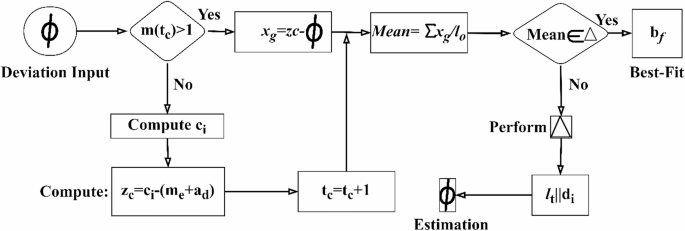
Best-fit detection decision illustration.
The \(\:\:{b}_{f}\)the solution is extracted if the \(\:\:mean\:\in\:\varDelta\:\)is true from \(\:\:{x}_{g}\:\forall\:m\left({t}_{c}\right)\). This case is validated using \(\:\:{x}_{g}\) and \(\:\:{z}_{c}\) for completed and classified \(\:\:\varphi\:\)inputs with the \(\:\:{c}_{i}\) consideration for more than 1 \(\:\:m\left({t}_{c}\right)\), the \(\:\:{x}_{g}\)is analyzed between the mean \(\:\:\varphi\:\)for any inputs and \(\:\:{l}_{o}\). Therefore the \(\:\:{b}_{f}\)pursues \(\:\:m\left({t}_{c}\right)>1\) and \(\:\:{\Delta\:}\)induced inputs for detecting performance and efficiency-oriented \(\:\:{l}_{o}\). In this case, the best fit is used as a recommendation-based output for multiple \(\:\:{c}_{i}\forall\:\alpha\:\left(\eta\:\right)\) and \(\:\:\alpha\:\left(\rho\:\right)\) (Refer to Fig. 8). the time and academic methods are considered here, and better output learning from the different teaching levels is performed. The best fit is derived from the decision-making approach associated with the fuzzy model. In this case, both the class level of teaching is performed and provides efficient performance for the strategies. Here, merging happens for the feasible output from the best fit. In this case, the following Eq. (12) is used to state the assessment monitoring for the levels of teaching based on the training.
$$\:M=\prod_{{q}_{i}}^{g{\prime\:}}\left({t}_{c}+\frac{{y}_{b}+{g}_{0}}{{b}_{f}}\right)+\left[\left({l}_{t}+{c}_{i}\right)+\left({f}_{v}\text{*}(I+{y}_{c})\right)\right].$$
(12)
The monitoring is performed in the above Eq. (12) and is symbolized as \(\:\:M\), and the merging is labeled as \(\:\:g{\prime\:}\). Here, merging is used to deploy the strategies and quality and determine the efficiency and performance. In this case, a constraint is observed, and the teaching method for the students is provided with best-fit values. The best fit is obtained by merging feasible output from the deviation factor. The computation is performed with the different sessions and evaluations, and the feasible solution is finally observed. The monitoring is used to perform a reliable assessment of every teaching and training method. After this merging process, the recommendation is performed from the previous session and is equated in Eq. (13).
$$\:R=\left({g}^{{\prime\:}}+{o}_{v}\right)\text{*}{p}_{g}+{m}^{{\prime\:}}+\left[\left(I+{f}_{v}\right)\right]\text{*}{l}_{t}+\left(\phi\:\text{*}{h}_{m}\right)+({m}_{e}+{a}_{d}).$$
(13)
The recommendation is observed in the above Eq. (13), and it is symbolized as \(\:\:R\), where the efficiency and performance are taken into consideration. The constraints are addressed, and the academic portion is covered within the fixed duration. In this process, the best fit is obtained from the derivation method. Thus, the recommendation is given as to whether it is a feasible output. This decision is made using the membership function, which provides a feasible solution for the teaching levels of sessions. Based on the \(\:\:{b}_{f}\)the performance and efficiency analysis is revisited for its recommendations.
During physical education classes, teachers may put into practice the system’s suggested lesson plan or training program. We track how well this suggestion works, and we may use the information from these sessions to make better selections. As a result of this iterative approach, PE technique evaluation and optimization may be fine-tuned to account for evolving student performance and other contextual variables. Ultimately, this proposed work’s FDSS uses fuzzy logic to manage the complexities and variations in physical education instruction, paving the way for better, more tailored learning experiences for students. This analysis is presented in Fig. 10.

Performance and efficiency revisiting with \(\:\:R\)analysis
The above illustration in Fig. 9 shows the after-math impact of \(\:\:{z}_{c}\)with \(\:\:{c}_{i}\) for the different methods for grades. The \(\:\:\alpha\:\left(\eta\:\right),\:\alpha\:\left(\rho\:\right)\), and their corresponding \(\:\:R\) for the varying \(\:\:{u}_{n}\)is analyzed in the above representation. Depending on the number of \(\:\:{l}_{o}\) and \(\:\:m\left({t}_{c}\right)\) the mean is varied accordingly for \(\:\:R\)extraction as the chances of \(\:\:{p}_{g}\)using \(\:\:{O}_{V}\) and \(\:\:c{\prime\:}\)are combined to generate a \(\:\:{b}_{f}\)the \(\:\:g{\prime\:}\)provides maximum \(\:\:R\). The fuzzy generates maximum \(\:\:{c}_{i}\) less chances for reducing suppression and thereby increasing the \(\:\:R\). The PE is observed periodically, and the strategies for the two methods discussed are improved: inclusive practice and professional development. In this process, the fuzzy derivatives only consider the best-fit (maximum efficient) teaching method. Therefore, the recommendations from the best fit are provided with a much better assessment from the previous sessions.
The following is the summary of the key features and innovations of an ATAM in PE teaching techniques, distinguishing this work from existing literature. In addition to test results, the descriptive evaluation techniques (Eqs. 1–4) consider various data-driven elements, such as student activities, goals, teamwork, and fitness development. One of the most important factors that set this work is the comprehensive modeling of PE-specific variables within the fuzzy framework. In the fuzzy decision model that has been proposed, a novel function of membership formulation is utilized. This formulation explicitly integrates PE time limits and student academic achievement as input variables. To be more specific, the membership function in Eq. (6) includes information about sessions, teaching time, student goals, and success indicators such as activities and planning.
In contrast to previous research, which primarily concentrated on test results or physical fitness indicators, this multi-factor membership function distinguishes itself from those studies. The model design utilizes a new “best-fit” solution extraction technique (Eqs. 9–11). This method examines fuzzy derivatives across many performance levels to choose the teaching strategy that is the most effective. This iterative refinement procedure, which uses data from earlier sessions, differentiates it from the fuzzy decision-making approaches that are typically utilized.
A short description of the comparative study part is given in Table 3.
In Fig. 11, the evaluation rate for the proposed work increases for the varying sessions based on hours and tasks/sessions that deploy 200 students. Here, the reform and innovation of PE are generated from the different teaching methods. In this case, efficiency and performance are examined, and constraints that include time and academics are avoided. The fuzzy model is introduced based on the derivation method and merges the feasible output. The examination of the session for PE is observed, and it is represented as \(\:\:\left(\left({q}_{i}+{g}_{r}\right)({{y}_{b}+{y}_{c}}/{{t}^{{\prime\:}}})\right)\). The periodic monitoring is attained in this PE and determines the time and academic reviews. Here, the recommendation system is performed for the teaching sessions and obtains the derivation, and it is formulated as \(\:\:\left({c}_{v}\text{*}{y}_{b}\right)+\frac{\left({q}_{i}+{y}_{c}\right)}{\left({o}_{z}\text{*}{r}^{{\prime\:}}\right)}\). The evaluation time to compute the best fit in this process is reduced, and the feasible output is observed merging. Here, the derivation is observed for the best-fit solution, where the feasible output is estimated for the recommendation. The processing method deploys efficiency and performance in this proposal work and provides a lesser evaluation rate.

The recommendation is improved, and the 100 students’ performance in this graph for the different sessions is observed based on hours and tasks/sessions. In this case, the time and academic method are considered and provide a better teaching session in PE. The efficiency is monitored and provides reliable output from the derivation process, and it is equated as \(\left(({\omega\:\text{*}r^{\prime\:}}/\:{{g}_{r}+{y}_{c}})/({\Sigma_{m^{\prime\:}}\left({n}_{l}\text{*}{o}_{z}\right)})\right)\). The performance is enhanced, and the membership function is determined to be better in this approach. This approach estimates the reliability of the time and academic methods. Here, efficiency is observed, and the derivation is used to obtain the best fit for this work. The approach determines the better extraction of PE time and covers the necessary academic portion. Based on this methodology, the merging is observed to improve the constraints and maintain the teaching session. Two types of teaching sessions are included in this study in which professional development and inclusive practice are considered. The computation process is obtained using these two methodologies to find the best fit (Fig. 12).

The classification model improved in this work for the varying sessions based on hrs. and tasks/sessions for analyzing 300 students. Equation (2) indicates the classification model for teaching methods, including professional development and inclusive practice. In this method, the membership function is used to state the efficiency and performance of this work and avoids the constraints. Both the time and academics are included in this case to obtain the teaching sessions among the students. From the classification model, the PE strategies are used, and it is formulated as \(\:\:\left[\left(\rho\:+t{\prime\:}\right)\text{*}\left({c}_{v}+{g}_{r}\right)\right]\). The derivation process is used to deploy the teaching methods and provides reliable output based on the derivation process. The organization of methods is examined for the activities and teamwork for the students, and it is represented as \(\:\:\left(\frac{{{y}_{b}-{g}_{r}}/{{n}_{l}+{o}_{z}}}{{{s}_{i}+{c}_{v}}/{{t}^{{\prime\:}}+{m}^{{\prime\:}}}}\right)\). In this case, the derivation is observed and provides the best-fit solution based on the goal set in the assessment. The PE teaching sessions are considered, and the goal setting from the evaluation method is examined to better the classification model (Fig. 13).

In Fig. 14, the evaluation time for the proposed work decreases for the 400 students in varying sessions based on HRs and tasks and sessions. Here, the time taken to compute the process is reduced for the 400 students, which is taken into consideration. Teaching sessions are considered for this case’s different strategies and recommendation models. The performance is observed in this model and provides the efficiency among the derivation methods. The best-fit solution is obtained at a shorter time. The derivation from the sigmoid function is used in this fuzzy logic system. The merging of the solution is observed by equating \(\:\text{}\left[\left(\text{I+}{\text{f}}_{\text{v}}\right)\text{+}\left(\frac{{\text{t}}_{\text{c}}\text{+}{\text{u}}_{\text{n}}}{\raisebox{1ex}{${\text{o}}_{\text{z}}\text{*}{\text{q}}_{\text{i}}$}\!\left/\:\!\raisebox{-1ex}{${\text{n}}_{\text{l}}$}\right.}\right)\right].\) Two methods are used to decrease the evaluation time among the 400 students and to provide the teaching session using different strategies. This method decides to generate the deviation factor for the best solution. The decision is made for the efficiency and performance development of the learning modules for every processing set. Thus, the evaluation time for the proposed methods is reduced in this case.

The output combination is enhanced in this work for the different HR sessions, tasks, and sessions that employ 300 students. In this proposed method, the academic portions are covered in fixed time duration, and from this, the processing step is included for reliable output and is represented as \(\:\:\left(\frac{{m}_{e}+{a}_{d}}{{c}_{i}+{u}_{0}}\right)\). The strategies work for the number of students in this graph 300 students are considered for the output combination where the mapping is observed between the current and previous state of the method and estimates the time and academic. The mapping model is used to obtain efficient results that determine the goal setting for the students. Based on this approach, the performance and efficiency are monitored and maintained. Thus, the derivation is formulated in this method, and the best fit from the derivation is. The combination of factors is considered to observe for the betterment of the result and provide the assessment level for the different strategies for different students. The combination is obtained from professional development and inclusive practice for the student-level improvement of the session (Fig. 15).

Comparative analysis
The Bi-LSTM algorithm was used because it is well-suited for time-series analysis, tracking the improvement of student fitness performance over many sessions. This aspect allows the model to forecast trends in future performance, enabling teachers to make predictive adjustments in instruction and improve exercise recommendation accuracy.
The Active Teaching Assessment Method (ATAM) that has been suggested has the best evaluation rate factor of 5.5, which means that it is more effective and comprehensive than other algorithm-based techniques (Table 4). An impressive recommendation value of 5.0 indicates that ATAM can provide practical instructional approaches. With 12 categories, it can handle various classroom situations and student requirements. Compared to other methodologies, ATAM’s evaluation time of 75 s is the shortest, indicating excellent efficiency. Lastly, an output combination percentage of 85% best integrates performance and recommendation indicators.
The “student activities” are exercise participation, “teamwork” collaborative capacity, “academic achievement” previous PE-related academic accomplishment, “test scores” tests of skill and fitness, and “fitness” students’ physical health status. All of them are factors that are elements for all-around assessment. They shed light on the fuzzy decision model to build individualized, adaptive teaching plans that maximize physical development and academic success in physical education classes.
Discussion
The experimental outcomes clearly show that the suggested Active Teaching Assessment Method (ATAM) based on Fuzzy Decision Support Systems (FDSS) attains noticeable improvements in all tested performance factors compared to conventional, big data-based, and deep-learning-based physical education (PE) methods. In particular, the ATAM model provides a higher evaluation rate, improved recommendation factor, wider classification range, shorter evaluation time, and greater output combination rate. This indicates that ATAM can render rapid, accurate, and dynamic assessments required by dynamic teaching and training scenarios.
The system can handle ambiguous, multi-dimensional data such as varying student fitness levels, recovery rates, academic achievement, and session capacity more effectively through fuzzy membership functions compared to stiff traditional practices. Furthermore, dynamic derivation mapping enabled adaptive fine-tuning session by session of teaching suggestions so adjustments were not fixed but continuously optimized based on real-time student feedback and changing conditions. Dynamic adaptability is a significant improvement over earlier static or one-size-fits-all education systems.
Nonetheless, although the proposed algorithm provides improvements within laboratory-tested conditions, challenges still need to be addressed. To begin with, the extent to which ATAM can be utilized with various student groups in varying educational institutions should be investigated more deeply. Educational institutions can have varied curriculum layouts, physical education schedules, socio-economic environments, and technology infrastructures that can affect the performance of the model. Secondly, though fuzzy decision systems are more versatile, they add complexity to rule creation and membership function calibration, for which expert intervention in implementation becomes necessary.
In addition, demographic heterogeneity, like age, gender, socio-cultural status, and levels of physical ability, was not directly addressed in the current study and ought to be covered in future model adaptations to facilitate greater generalizability and fairness. Another drawback is the reliance on adequate and quality data collection; in low-resource environments where such data are scarce or of inferior quality, the full potential of the fuzzy model cannot be fulfilled. Despite these constraints, the results strongly promote the feasibility, adaptability, and pedagogical merit of applying fuzzy decision support systems to reform physical education pedagogies. By facilitating individualized, real-time, data-driven teaching interventions, the ATAM framework addresses the need for more inclusive, efficient, and responsive PE pedagogies in today’s schools.
Future studies might include integrating machine learning algorithms for fuzzy rule optimization on an automated level, multi-institution pilot trials to evaluate scalability, and incorporating psychological and behavioral engagement measures to develop even more comprehensive assessment models.
link