Exploring Chinese university students’ foreign language enjoyment, engagement and willingness to communicate in EFL speaking classes
Positive psychology in SLA and broaden-and-build theory
Positive psychology has emerged as a foundational framework for understanding language learning processes, marking a significant shift from traditional approaches that primarily focused on negative emotions in SLA. This shift, initiated by Seligman and Csikszentmihalyi’s (2000) seminal work, redirected attention toward human strengths and optimal functioning rather than weaknesses (Polly et al., 2009). In the context of SLA, this reorientation has particular significance because emotions, though crucial to language learning (Dewaele, 2015), were historically disregarded as unreasonable elements (Joe et al., 2017). Since its introduction to SLA research, it has transformed the understanding of how positive emotions influence language learning success and student well-being (Li, 2018).
The study is theoretically grounded in Fredrickson’s (2001) Broaden-and-Build theory, which emerged from the positive psychology movement in SLA. The theory aligns with positive psychology’s aim to promote factors that contribute to human flourishing, showing how positive emotions in language learning can build enduring personal resources and enhance learning outcomes (MacIntyre and Gregersen, 2012). The integration of positive psychology principles and the Broaden-and-Build theory in SLA research has created an “emotional wave” (MacIntyre et al., 2016), emphasizing the need to consider both positive and negative emotions in understanding language learning processes and their complex interactions in the learning process (Li et al., 2018).
The Broaden-and-Build theory presents a distinctive perspective on how positive emotions facilitate language learning by proposing that positive emotions serve two complementary functions: they ‘broaden’ learners’ momentary thought-action repertoires and ‘build’ their enduring personal resources (Fredrickson et al., 2008). The theory distinguishes between the functions of positive and negative emotions in language learning. While negative emotions narrow attention and promote specific behavioral tendencies, positive emotions create inclinations toward exploration and play, broaden attention, and build resources for future action (Fredrickson, 2001). These resources can include social support, coping skills, and self-efficacy, which enhance learners’ resilience in language learning (Fredrickson, 2001). Specifically, the theory suggests that positive emotions like FLE can facilitate language learning by creating optimal conditions for cognitive processing, motivation, and social interaction (MacIntyre and Gregersen, 2012). More importantly, the Broaden-and-Build theory has provided crucial insights into understanding emotional dynamics in language classrooms in SLA research (Dewaele and MacIntyre, 2014) and how emotional experiences interact with other crucial variables in language learning, such as engagement and WTC, ultimately influencing learning outcomes and communicative behavior. This theoretical framework is particularly relevant to our study as it helps explain how FLE might enhance both engagement and WTC in Chinese EFL classrooms.
Foreign language enjoyment
Positive emotions play a fundamental role in SLA, particularly in broadening learners’ cognitive processes and building their linguistic competencies (Fredrickson, 2001). Scholars have examined the various functions and impacts of positive emotions in their studies (Dewaele and MacIntyre, 2014; Li, 2020; Wang et al., 2021, 2022).
Among these positive emotions, FLE has emerged as a particularly significant construct in SLA research. Dewaele and MacIntyre (2019) identified enjoyment as the most frequently observed positive emotion in language classrooms, especially as a counterbalance to the traditionally studied foreign language anxiety. FLE was defined by Li et al. (2018) as a positive emotion influenced by “peers, teachers, the environment, and a sense of accomplishment” (p. 193). This concept has gained increasing attention within the positive psychology movement in SLA over the last 10 years (Dewaele et al., 2017).
Empirical evidence strongly supports the positive influence of FLE on various learning outcomes within the positive psychology framework. The pioneering research by Dewaele and MacIntyre (2014) demonstrated that positive and negative emotions serve distinct functions in language learning rather than existing as opposite poles on the same axis. Specifically, much research has demonstrated the positive effect of positive emotions on motivation, engagement, and academic achievement (Li, 2020). The theoretical foundation for these impacts lies in enjoyment’s capacity to expand learners’ thought-action repertoire, thereby enhancing their ability to develop language resources and facilitate learning (MacIntyre and Gregersen, 2012). Furthermore, the development and validation of a culturally adapted Chinese FLE Scale by Li et al. (2018) offers a three-dimensional framework encompassing private, teacher, and atmosphere, contributing to context-specific conceptualizations of FLE.
Therefore, it reveals that while significant progress has been made in understanding FLE, there remain substantial gaps in existing research. While substantial evidence supports its positive impact on language learning outcomes, the nomological network of enjoyment remains incompletely explored. Particularly, the complex interrelationships between FLE and other variables in L2 contexts need further investigation, suggesting a promising direction for future research in this field. In other words, while FLE has emerged as a crucial construct in SLA research, further studies are needed to fully comprehend its complex interactions within the field of SLA.
Engagement
As previously noted, engagement is a key element of positive psychology (Seligman, 2011; Wang and Wang, 2024). Initially considered a relatively novel concept compared to constructs like motivation (Reschly and Christenson, 2012), engagement has gained increasing attention from researchers and has become more prominent in educational research (Pan et al., 2023; Pekrun and Linnenbrink-Garcia, 2012; Wang et al., 2024; Wu et al., 2024). Engagement is defined as the concept of “how actively involved a student is in a learning task and the extent to which that physical and mental activity is goal-directed and purpose-driven” (Hiver et al., 2021, p.3). This definition emphasizes the importance of both physical participation and cognitive investment, suggesting the need for clear objectives and personal meaning in educational activities (Gao et al., 2025; Guo and Wang, 2024; Wang et al., 2025; Wang and Reynolds, 2024). The concept of student engagement in SLA has evolved from two dimensions—behavioral and emotional (Van Uden et al., 2013)—to three, with the addition of cognitive aspects (Fredricks et al., 2004). Recently, a four-dimensional model has included agentic engagement (Reeve, 2013). This shift showed that L2 learning represents a complex interplay of cognitive, affective, and social variables (Sato, 2017). More importantly, among these dimensions, behavioral engagement is most closely associated with academic performance (Lee, 2014) and learner achievement (Wong et al., 2024). This dimension is generally characterized by the observable persistence and effort that learners invest in educational activities (Hughes et al., 2008).
Notably, engagement serves as a crucial bridge between teaching and learning, facilitating meaningful learning experiences (Hiver et al., 2021). Many researchers have examined its positive relationship with multiple learning outcomes across academic, social, and affective domains (Reeve, 2012). Specifically, engagement has been linked to achievement, motivation, and self-efficacy (Mystkowska-Wiertelak, 2021). That is to say, engagement is often considered a psychological mediator that influences student performance through many contextual factors (Reyes et al., 2012; Benner et al., 2008).
More importantly, emotions and engagement are crucial components in SLA research, significantly impacting both learning and psychological well-being (Feng and Hong, 2022). Boekaerts (2016) highlights that both positive and negative emotions significantly influence engagement. Notably, engagement has been positively linked to FLE in language learning (Feng and Hong, 2022; Khajavy, 2021; Linnenbrink-Garcia et al., 2011). When studying engagement, researchers need to explore how positive emotions can influence students’ engagement (Boekaerts, 2016). For example, Khajavy (2021) found that FLE positively predicted engagement among Iranian L2 learners. In the Chinese EFL context specifically, Feng and Hong (2022) demonstrated this relationship while noting that Chinese students generally reported lower enjoyment levels compared to the Western counterparts. Furthermore, this relationship is supported by Fredrickson’s (2001) Broaden-and-Build theory, which argues that positive emotions of enjoyment can enhance engagement. Apart from that, research examining the relationship between engagement and WTC is crucial for understanding classroom interaction dynamics. Mystkowska-Wiertelak’s (2021) study of English majors found significant correlations between engagement and WTC dimensions and found that these constructs were also heavily influenced by social factors. Although earlier research predominantly explored the bivariate relationships between enjoyment and engagement (Do and Schallert, 2004) or the relationships between engagement and WTC, there remain few empirical studies investigating the mechanisms underlying these relationships. Therefore, it is crucial to investigate the intricate mechanisms underlying these concepts.
In summary, previous SLA studies have primarily concentrated on linguistic perspectives of engagement, such as grammatical and lexical features. However, the broader definition of engagement in education includes psychological dimensions, which have often been neglected. In this study, we primarily focus on behavioral engagement, which is defined as “the involvement time, persistence to learning activities and efforts of participation” (Teng and Wang, 2021, p.3). It includes participation in interactions with classmates and teachers, and the quality of these social interactions. Behavioral engagement is particularly relevant because it directly influences the dynamics of classroom interaction and the overall learning environment. The rationale for focusing on behavioral engagement in this study lies in that it is more observable and measurable than other dimensions, and it can facilitate systematic assessment and analysis within an educational context (Fredricks et al., 2004). Furthermore, behavioral engagement was found to be intrinsically linked to academic success (Hughes et al., 2008), as students who are more behaviorally engaged may demonstrate greater persistence, effort, and active participation, all of which are crucial for effective learning (Reeve, 2012). Given that engagement is crucial for academic success, it is essential to investigate its psychological dimensions within SLA to gain deeper insights into this field.
Willingness to communicate (WTC)
WTC in SLA represents a complex and dynamic construct that significantly influences foreign language teaching and learning outcomes. Initially conceptualized by McCroskey and Richmond (1987) as a stable trait in L1 contexts, WTC has evolved to encompass “a readiness to enter into discourse at a particular time with a specific person or persons, using an L2” in L2 contexts (MacIntyre et al., 1998, p. 547). The evolution reflects the recognition that L2 WTC varies considerably among learners due to their diverse linguistic competencies and communicative opportunities (Khajavy et al., 2018).
The theoretical framework of L2 WTC has undergone significant development over the past 20 years, transforming from viewing it as both a situational and trait variable (MacIntyre et al., 1998) to encompassing process-oriented, ecological, and dynamic perspectives (Cao and Philp, 2006; Cao, 2009; MacIntyre and Legatto, 2011). This model emphasizes that effective L2 communication requires not only linguistic competence but also psychological readiness (Khajavy et al., 2018). Furthermore, the pyramid model suggests that WTC variations emerge from interactions between linguistic, communicative and contextual factors (Khajavy et al., 2018). This is validated across diverse contexts, including the Korean context (Joe et al., 2017), the Chinese context (Peng and Woodrow, 2010), the Japanese context (Yashima, 2002) and the Iranian context (Khajavy et al., 2016).
Empirical research has identified numerous factors influencing L2 WTC, including both long-term processes and immediate situational variables (Khajavy et al., 2018). In Chinese EFL contexts, Peng and Woodrow (2010) established the classroom environment’s predictive role in WTC development, while Wang (2019) demonstrated WTC’s dynamic nature through moment-to-moment fluctuations. However, there still exists a significant research gap in understanding the relationship between contextual psychological factors, particularly enjoyment, and L2 WTC. While Dewaele and MacIntyre (2016) suggested that teachers can more effectively influence students’ language enjoyment compared to anxiety, the complex interplay between positive emotions and WTC remains underexplored. This limitation is particularly noteworthy given the multitude of potential WTC predictors. Therefore, it is necessary to further explore the associations between FLE and WTC across diverse learning contexts, potentially enhancing our understanding of effective L2 communication environments. Emotions and engagement play critical roles in learning and psychological well-being (Feng and Hong, 2022), yet a significant research gap exists in understanding the nomological network of enjoyment in SLA (Botes et al., 2020). While previous studies often examined simple bivariate relationships between these variables, recent research suggests more complex interconnections between FLE, behavioral engagement, and WTC in language learning contexts.
The positive relationship between FLE and engagement has been consistently supported across multiple studies (Feng and Hong, 2022; Khajavy, 2021; Nalipay et al., 2021). This alignment with Fredrickson’s (2001) Broaden-and-Build theory demonstrates that positive emotions enhance engagement by increasing involvement in learning activities. Similarly, research has consistently shown positive correlations between FLE and WTC in language classrooms (Bensalem, 2022; Dewaele and Pavelescu, 2021; Peng and Wang, 2024), with enjoyment being identified as the most prevalent positive emotion facilitating communication willingness (Dewaele and MacIntyre, 2019). However, several contradictions emerge in the literature. First, while FLE generally shows positive effects across contexts, studies reveal significant cultural differences. Feng and Hong (2022) found that Chinese students report higher anxiety and lower enjoyment compared to Western samples, suggesting that the relationship between emotions and engagement may be culturally mediated. Second, contradictory findings exist regarding the stability of these relationships. While some studies present these relationships as relatively stable (Khajavy et al., 2018), Dewaele and Pavelescu’s (2021) longitudinal research reveals that emotions and their connection to WTC are highly dynamic and fluctuate over time. Third, while Kun et al., (2020) found strong positive correlations between FLE and WTC among Chinese tertiary students with high FLE levels, the relationship varies significantly among students with different proficiency levels and in different learning contexts.
Several research gaps still exist. First, while the dynamic nature of emotions in relation to WTC has been established, the specific mechanisms driving these fluctuations remain unclear, particularly in the Chinese EFL context. Second, most studies examine these variables in pairs rather than investigating their simultaneous interactions in speaking classes. Therefore, this complex interplay between emotions, engagement, and WTC, along with the contradictory findings in different contexts, necessitates a more comprehensive approach to understanding how these variables function together in language learning. It is crucial for developing more effective teaching practices that account for the full range of emotional and behavioral dynamics in language learning environments.
The conceptual framework
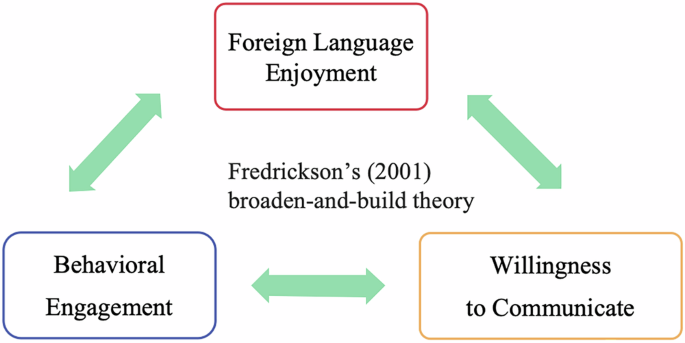
The selection of FLE, behavioral engagement, and WTC as key constructs in this study is theoretically grounded in Fredrickson’s (2001) Broaden-and-Build theory and specifically justified by their crucial roles in EFL speaking contexts. These three constructs form an interconnected framework that captures both the emotional and behavioral dimensions of language learning. FLE was selected as it represents the most prevalent positive emotion in language classrooms (Dewaele and MacIntyre, 2019) and aligns with the broadening function. In the Chinese EFL context, where speaking anxiety often acts as a barrier (Jiang and Dewaele, 2019), the potential of FLE to counteract negative emotions makes it particularly relevant. Behavioral engagement, defined as students’ active participation in language learning activities, is more observable and measurable than other dimensions of engagement. This behavioral aspect is especially critical in Chinese EFL classrooms, where traditional teaching methods may limit active participation opportunities. WTC was chosen as the outcome variable as it embodies the ‘building’ aspect of the theory and represents the ultimate goal of language education: students’ readiness to engage in L2 communication, which is particularly significant in the Chinese EFL context where students often demonstrate high linguistic competence but lower communication willingness (MacIntyre et al., 2019). Therefore, in the context of this study, it is plausible that FLE facilitates increased behavioral engagement in classroom activities, which in turn develops students’ WTC in language learning.
Figure 1 shows the conceptual framework of the study. The present framework divides WTC into two dimensions according to Peng and Woodrow’s model (2010): form-focused activities, which emphasize specific language features and meaning-focused activities, which emphasize message exchange. The variable FLE is composed of three dimensions, which were established from the Chinese FLE Scale in Li et al.’s (2018) study. These dimensions are defined as follows: FLE-Private, which is personal pleasure from progress and performance; FLE-Teacher, which is the pleasure from EFL teacher support; FLE-Atmosphere, which is the enjoyment from positive classroom atmosphere. The variable behavioral engagement is adapted from Khajavy’s (2021) scale, including four items measuring engagement in behavioral aspects.

This figure illustrates the hypothesized relationships between the key constructs examined in this research.
link