Factors influencing the acceptance and use of ChatGPT among English as a foreign language learners in Saudi Arabia
AI-powered language learning
Research on artificial intelligence (AI) chatbots as conversational partners to improve language learning has flourished dramatically in recent years (Liu and Ma 2024). An important direction for these studies is how AI chatbots enable language learners to practice English as a foreign language (EFL) through verbal or written interactions with the chatbot (e.g., Asad et al. 2024; Fathi et al. 2024; Han 2021; Imran and Almusharraf 2023; Jeon 2024; Kim et al. 2021; Lee et al. 2024; Yang et al. 2022). For instance, Han (2020) examined the effect of voice-based AI chatbots on the speaking competence of 44 Korean EFL learners. A pre-and post-test experimental design was employed, including a 10-week treatment for the experimental group, during which the participants engaged in chat sessions with a voice-based AI chatbot. The results revealed that the interaction with the AI chatbot led to a significant improvement in EFL learners’ speaking ability. The results also showed that the learners’ attitude toward the use of AI chatbots in EFL classrooms was significantly positive. Likewise, Ebadi, Amini (2024) examined the interaction of 256 Iranian EFL learners with an AI chatbot. Data were collected through audio-recorded practices; transcriptions; three scales of social presence, learner motivation, and human-likeness; and semi-structured interviews. The results strongly indicate that learners’ confidence and motivation to learn English were positively influenced by chatbot accuracy and human likeness. Another relevant study from Saudi Arabia is that of Qasem et al.,(2023) who explored the usefulness of an AI chatbot in learning specialized vocabulary. The results of the quantitative and qualitative analyses showed that the use of chatbots is crucial in enhancing learners’ specialized vocabulary. The chatbots created effective interactive environments to advance EFL learners’ lexical development.
In addition to studies conducted on the use of chatbots in EFL classrooms, few studies have attempted to explore the use of AI chatbots in constructing effective self-directed learning spaces. For instance, Esiyok et al., (2024) examined the educational use of AI chatbots for self-directed learning with technology (SDLT) along with information and communication technology (ICT) self-efficiency. Data were collected from 414 Turkish EFL learners via a survey following the extended TAM (explained below). The results showed that the SDLT positively influenced the intention and actual use of AI chatbots. Additionally, perceived ease of use and usefulness positively affected learners’ intentions to use AI chatbots. Belda-Medina, Calvo-Ferrer (2022) also conducted another study. In their mixed-methods study, Belda-Medina, Calvo-Ferrer (2022) examined the effects of applying AI chatbots to EFL learners’ autonomous language learning activities beyond the classroom. Data were collected from 115 Spanish and 61 Polish EFL students. The results revealed that learners’ perceived usefulness, acceptance, and actual use of AI conversational robots for informal language learning were positively influenced by specific linguistic and technological features of the chatbots.
Recently, ChatGPT, one of the most advanced chatbots built on OpenAI’s large language models (LLMs), was introduced and has thus appeared to revolutionize foreign language education in terms of how language is learned, taught, and assessed (Liu and Ma 2024). These systems represent a significant evolution in the capabilities of AI tools for language learning. Unlike earlier conventional AI technologies, which often relied on rule-based systems, pre-programmed dialogues, or corpus-based language learning tools (e.g., grammar checkers, translation software, and chatbot scripts), generative AI based on LLMs leverages vast amounts of data to generate contextually relevant and nuanced language interactions, adapt to learners’ proficiency levels and individualized needs and simulates real world dialogues and cultural contexts. This exceptional capability not only promotes the students’ experience but also provides opportunities for personalized learning pathways that were previously unattainable. Hence, scholars (e.g., Bekou et al. 2024; Imran et al. 2024; Kim and Park 2023; Mohamed 2024) have begun to explore the use of this advanced chatbot, which has demonstrated its ability to learn and even transcend human intelligence (Zhou et al. 2023). For instance, Xiao and Zhi (2023) conducted a small-scale qualitative study to investigate Chinese EFL learners’ experiences with ChatGPT and their perceptions toward its use in language learning. The results showed that ChatGPT can serve as an effective learning partner for participants and assist them in completing EFL learning tasks. Interestingly, the participants exhibited an awareness of how the quality of ChatGPT output needs to be scrutinized and demonstrated the ability to modify prompts to improve language learning. Similarly, Song and Song (2023) conducted a mixed-methods study to evaluate the impact of ChatGPT use on improving learners’ writing skills and motivation. Writing samples of the AI-instructed and traditionally instructed groups were evaluated using scoring rubrics, and semi-structured interviews were conducted. The results revealed significant improvements in both writing skills and motivation among learners who received ChatGPT-assisted instruction compared with the control group. The qualitative results generally reflected positive feedback from ChatGPT users, who recognized its innovative instructional role.
Interest in exploring the use of ChatGPT in foreign language education also appeared in the Saudi context which, in light of Vision 2030, highly emphasizes the importance of digital transformation in all fields and the use of the most updated AI tools to enhance efficiency, productivity and innovation in all disciplines (e.g., Abed 2024; Abedalrhman and Alzaydi 2024; Althubaiti and AlYousef 2024). The Saudi Vision 2030 is a reform plan that was launched in Saudi Arabia in April 2016. The main Aim is to diversify the Saudi economy and reduce dependency on oil. It has several initiatives focusing on three main pillars: vibrant society, a thriving economy, and an ambitious nation. The key objectives involve enhancing the quality of life for citizens, promoting cultural and recreational opportunities, and fostering a robust private sector. Vision 2030 also emphasizes the importance of digital transformation, innovation, and sustainable development, aiming to position Saudi Arabia as a global leader in various sectors, including the education sector.
In the Saudi context, most studies on the use of ChatGPT in language education (e.g., Ali 2023; Alharthi 2024; Alqahtani 2024; Alsalem 2024; Jamshed et al. 2024; Ozfidan et al. 2024) examined the perceptions of students and/or teachers in different high schools and universities towards the integration of this chatbot in language learning, in general, or a specific language skill, such as speaking or writing, in particular. The findings generally showed a positive attitude towards the potential integration of ChatGPT in language learning by both students and teachers. Both groups highlighted several benefits of the use of ChatGPT, including immediate feedback, personalized learning, academic support, and improved language learning experience. However, the participants also expressed their concerns regarding the ethical and responsible use of ChatGPT in language learning, particularly with reference to plagiarism, decreased creativity and critical thinking and overreliance on the tool in doing assignments. In addition to these studies, fewer studies have adopted an experimental approach in which an experimental group using ChatGPT was compared with a control group. Such studies (e.g., Aldowsari and Aljebreen 2024; Mugableh 2024) highlighted that students’ performance and motivation improved with the use of ChatGPT in language learning. The authors, thus, recommended the provision of capacity building programs for educators to support the incorporation of ChatGPT in language learning particularly in light of the remarkable technological and digital infrastructure of Saudi Arabia.
The current study contributes to this recent line of research on the use of ChatGPT to improve EFL learning. It extends the research conducted by Liu and Ma (2024) from the Chinese to the Saudi context. Liu and Ma (2024) examined the extent to which ChatGPT learners perceived and leveraged by Chinese EFL learners beyond the classroom. Similar to Esiyok et al., (2024), Liu and Ma (2024) used a questionnaire that drew upon the TAM (to be explained below). The questionnaire was completed by 405 Chinese EFL learners and the data were analysed using structural equation modelling. The results revealed that participants’ perceived ease of ChatGPT use influenced learners’ attitudes through the full mediator of their perceived usefulness but not directly. They also showed that having a positive attitude toward the usefulness of ChatGPT was positively correlated with a higher level of behavioural intention, and, thus, led to an increase in the actual use of ChatGPT in learning outside the classroom. Liu and Ma’s (2024) work, therefore, lent support to the potential of ChatGPT as a powerful learning partner to EFL learners in China. Inspired by these results, this study extends this work by exploring the extent to which ChatGPT is used among Saudi Arabia post-secondary EFL learners and their perceptions regarding its use in EFL learning in general, not only in informal extramural settings, as was the case in Liu and Ma (2024). Thus, the current study fills a gap that previous studies in the Saudi context did not address because (1) it employs the use of the TAM model to examine the acceptance of EFL students and (2) incorporates other important factors, including gender, educational level, duration of ChatGPT use, and IT skill level which will be explained in detail later in the article.
By focusing on this niche, our study aims to bridge this gap and illuminate the distinct factors influencing the adoption of LLMs in EFL learning, thereby providing insights that are crucial for educators and researchers seeking to integrate cutting-edge AI tools into language learning curricula. Therefore, this study employs an adapted version of Liu and Ma’s (2024) survey built upon the TAM. Hence, an explanation of the TAM model is deemed necessary and is detailed in the next section.
Technology acceptance model
The TAM was developed by Davis (1986, 1989), who is a prominent figure in information management. The TAM has been extensively employed to explore individuals’ acceptance, rejection, and usage of information technologies in various disciplines, including education, e-commerce, entrepreneurship, medicine, and information management (e.g., Bonfanti et al. 2023; Kamal et al. 2020; Park and Park 2020; Saif et al. 2024; Wang et al. 2023). Interestingly, TAM has also been widely used to investigate individuals’ acceptance and use of AI-based chatbots (e.g., Al-Abdullatif 2023; Chocarro et al. 2023; de Andrés-Sánchez and Gené-Albesa 2023; Goli et al. 2023; Iancu and Iancu 2022; Zou and Huang 2023).
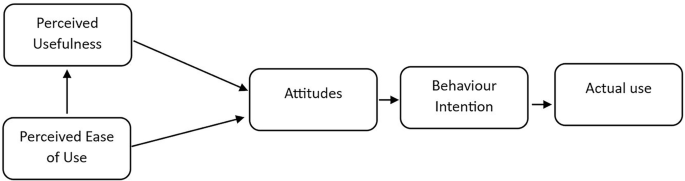
This influential framework, which has been tested over the last three decades, has been successfully used to predict individuals’ adoption of new technologies. This model is based on the basic relationship among attitude, intention, and behaviour (Davis, 1989). In this context, attitude refers to the extent to which individuals exhibit an interest in and how they assess new technologies. Attitudes are influenced by two factors: the perceived ease of use and perceived usefulness. Perceived ease of use refers to the extent to which using a specific technology does not require effort, whereas perceived usefulness refers to the extent to which using a particular technology can enhance one’s performance on the relevant tasks. Attitude influences one’s intention to use a specific technology, and intention can, in turn, predict an individual’s behavioural practices while using the target technology. For more detailed definitions of the model constructs, refer to Table 1.
Several scholars have attempted to extend the TAM by adding new dimensions to the model, such as subjective norms and computer self-efficacy (e.g., Bailey et al. Yang and Wang 2019). However, the essence of the model remains the attitude-intention-behaviour relationship, along with the constructs of perceived ease of use and perceived usefulness, as shown in Fig. (1).

Hypothesized conceptual model.
As mentioned above, this study employed a TAM-informed survey to explore how ChatGPT, one of the most capable chatbots worldwide, is perceived and used by Saudi post-secondary EFL students to improve their English language skills. Thus, this study extends the research conducted by Liu and Ma (2024) to a new context (Saudi rather than Chinese) and setting (EFL in general, instead of the constrained focus on informal and extramural settings). This study can enhance our understanding of postsecondary students’ potential adoption of ChatGPT to learn foreign languages and expand the horizon of ChatGPT studies to a new, relatively underexplored population. To achieve this, this study proposes several hypotheses (see Fig. 1).
-
1.
Perceived ease of use (PEU) of ChatGPT has a significant influence on L2 students’ perceived usefulness (PU).
-
2.
PU of ChatGPT significantly influenced L2 students’ attitudes (AT).
-
3.
PEU of ChatGPT has a significant influence on L2 students’ attitudes (AT).
-
4.
The L2 students’ attitudes (AT) towards ChatGPT use had a significant influence on their Behavioural intention (BI).
-
5.
L2 students’ behavioural intention towards the use of ChatGPT has a significant influence on their actual use (AU).
-
6.
PU of ChatGPT mediates the relationship between Perceived ease of use (PEU) and attitudes (AT).
The study hypotheses are based on the suggestions and recommendations of earlier studies in the literature. Regarding Hypothesis (1), several studies (e.g., Li 2023; Liu and Ma 2024; Shaengchart 2023) have validated the relationship between TAM’s PU and PEU of TAMs. In Hypotheses (2) and (3), some earlier studies have noted that participants develop a positive attitude toward the use of ChatGPT and AI technologies based on several variables, including PU (e.g., Abdaljaleel et al. 2024; Liu and Ma 2024; Sallam et al. 2024) and PEU (e.g., Menon and Shilpa 2023; Sallam et al. 2024). Hypothesis 4 was motivated by a recurrent finding in the literature that participants’ AT was a significant predictor of their BI when using ChatGPT (e.g., Liu and Ma 2024; Zou and Huang 2023). Hypothesis 5 reflects the findings of earlier studies that participants’ BI has a significant effect on their AU of ChatGPT and AI tools (e.g., Qu & Wu 2024; Strzelecki (2024); Zou and Huang 2023). Finally, Hypothesis 6 is based on repeated reports that participants’ PU serves as a dominant mediator between their PEU and attitude (e.g., Qu and Wu 2024; Sallam et al. 2024; Zou and Huang 2023).
In addition to these main hypotheses, we examined the effect of four participant-related factors on the five TAM constructs. These factors were chosen based on a literature survey on potential variables that could influence the TAM constructs. The first factor is gender. Our interest here was to examine if men and women vary in their acceptance of the use of ChatGPT in the Saudi EFL context. The inclusion of this variable was motivated by earlier findings that pointed out that gender differences may emerge while dealing with AI technologies. For instance, Goswami and Dutta (2016) examined the choice of the gender variable, concluding that men have more expertise in technology than women in the ICT context. This was also influenced by earlier studies such as Albarrán Lozano et al., (2021), who highlighted that men were more interested than women in technological developments. More recently, Elshaer et al., (2024) examined the moderating effect of gender in the relationship between university students’ acceptance and use of ChatGPT in Saudi Arabia. The results pointed to a significant moderating effect of gender on the relationship between performance expectancy and ChatGPT usage. Men demonstrated a stronger performance expectancy level in fostering ChatGPT than women. Moreover, social influence was shown to significantly affect males more than females in relation to ChatGPT usage Fig. 2.

The Final Structural Model.
The second factor we examined in the present study is the participants’ educational level. We wanted to explore if one’s educational level (e.g., BA, MA, PhD, etc.) could affect their level of acceptance of the incorporation of ChatGPT in foreign language education. The focus on the educational level was grounded in the literature which includes mixed results about the potential impact of the educational level on technology acceptance. For example, Vo and Nguyen (2024) found that the educational level of students significantly affected the effectiveness of using ChatGPT in language learning and teaching. Similarly, Ma et al., (2024) found that the participants’ educational level was a notable predictor in people’s intentions to use ChatGPT. However, Yilmaz et al., (2023) did not find any significant effect for the grade level on the acceptance of university students of ChatGPT in a private university in Kazakhstan. Against this backdrop, our study will contribute to our understanding of the effect of the educational level on the ChatGPT acceptance in Saudi Arabia.
In addition to gender and the educational level, we examined two other participant-related factors that are more exploratory in nature. We wanted to explore if the duration one has used ChatGPT and one’s digital competence (or level of IT skills) (e.g., beginner, medium, advanced) could influence their acceptance level of ChatGPT in the EFL context. The literature has preliminary findings in this regard, which leaves a clear gap that needs to be filled. Regarding the duration of ChatGPT use, we considered the findings of a few earlier studies showing that the participants’ experience of use was a factor conditioning facilitation in all TAM constructs (Romero-Rodríguez et al. 2023), particularly with regard to the perceived ease of use (Zou and Huang 2023). We wanted to explore if the same findings will apply with ChatGPT. As for the IT skill level variable, we considered the earlier studies that found positive and significant relationships between participants’ digital competence and their beliefs about the technological ease of use and perceived usefulness of technology (Antonietti et al. 2022; Panagiotarou et al. 2020). In these studies, teachers’ digital competence belief directly influenced beliefs about technology.
link