Generative artificial intelligence in entrepreneurship education enhances entrepreneurial intention through self-efficacy and university support
Theory of planned behavior
The Theory of Planned Behavior (TPB) provides a robust and widely validated framework for deciphering the antecedents of individual behavior, particularly within the domain of entrepreneurial intention13,20. In its foundational form, TPB postulates that an individual’s behavioral intention is the most proximal determinant of actual behavior, and this intention, in turn, is shaped by a confluence of three factors: attitudes toward the behavior, subjective norms, and perceived behavioral control15. When applied to the context of nascent entrepreneurship, these factors can be operationalized as an individual’s personal evaluation of entrepreneurial activities, the perceived social pressure to engage in (or refrain from) such activities, and a self-assessment of one’s capability to successfully execute the tasks inherent in launching and managing a new venture21.
However, while traditional applications of TPB have provided valuable insights into the formation of entrepreneurial intention22 the rapidly evolving landscape of higher education, particularly the advent of GAISEE, necessitates a more nuanced and expanded theoretical perspective. This study, therefore, extends the traditional TPB model in two critical ways. First, it explicitly incorporates the construct of entrepreneurial self-efficacy, conceptualized as an individual’s belief in their ability to successfully perform the multifaceted tasks associated with entrepreneurship23. This is not merely a semantic adjustment; entrepreneurial self-efficacy aligns closely with TPB’s perceived behavioral control but provides a more granular and domain-specific lens through which to examine the individual’s perceived capabilities within the entrepreneurial context. As such, we posit that accurately measuring entrepreneurial self-efficacy enhances the predictive power of the model, particularly in a technology-infused educational setting. Second, recognizing the profound influence of the institutional context on student behavior, we introduce the university ecosystem as a critical moderating variable. This expansion acknowledges that the university environment, encompassing factors such as resource availability, programmatic support, and cultural norms, can significantly amplify or dampen the effects of both GAISEE and entrepreneurial self-efficacy on entrepreneurial intention. By integrating these elements, the study pushes beyond a purely individual-level analysis of entrepreneurial intention formation, acknowledging that intention is not formed in a vacuum but is instead deeply embedded within a broader socio-technical ecosystem24. This expanded theoretical lens, therefore, underscores the novelty and adaptability of TPB to the exigencies of the new technological era, demonstrating its continued relevance in understanding the complex interplay between individual cognition, technological advancements, and institutional support in shaping entrepreneurial behavior. This new approach is important because it helps us understand how technology and support systems can work together to encourage more students to become entrepreneurs.
Generative artificial intelligence supported entrepreneurship education
GAISEE represents a fundamental departure from conventional pedagogical approaches, marking a paradigm shift in how entrepreneurship is taught and learned in higher education institutions11,25. Unlike traditional entrepreneurship education, which often relies heavily on passive knowledge transfer through lectures and case studies, GAISEE leverages the unique capabilities of generative AI to create a dynamic, interactive, and highly personalized learning environment5. This is not merely an incremental improvement but a qualitative shift in educational methodology. The core innovation of GAISEE lies in its “generative” nature. Instead of pre-packaged content and predetermined learning pathways, students actively engage with AI tools that can generate realistic business simulations, create novel product ideas, simulate market scenarios, and provide tailored feedback on student-generated business plans26.
This immersive and experiential approach fosters a deeper level of cognitive engagement, enabling students to not only learn theoretical concepts but also apply them in a simulated environment that closely mirrors the complexities of real-world entrepreneurship, moving from abstract concepts to concrete application. For example, students can use generative AI to develop and test marketing campaigns, analyze competitor strategies, and even simulate the process of securing funding. Such activities were rarely feasible with traditional methods and only available to a select few through internships or specialized programs. Furthermore, GAISEE’s inherent adaptability, driven by continuous content generation and AI-powered feedback loops, allows for real-time adjustments in teaching strategies based on individual student progress and learning styles27. This stands in stark contrast to the relatively static and uniform curricula characteristic of conventional entrepreneurship education. The flexibility afforded by GAISEE allows educators to personalize learning paths, catering to the unique needs and strengths of each student, thereby fostering a more inclusive and effective educational experience. This personalized approach accelerates learning and deepens understanding.
By providing these immersive, adaptive, and personalized learning experiences, GAISEE not only enhances students’ technical knowledge of entrepreneurship but also cultivates their problem-solving skills, critical thinking abilities, and entrepreneurial mindset, preparing them to navigate the uncertainties and challenges of the modern business environment28. This transformative potential of GAISEE, therefore, extends beyond simply improving existing educational practices; it opens up entirely new avenues for cultivating entrepreneurial intention and nurturing a new generation of entrepreneurs equipped with the skills and mindset to thrive in an increasingly complex and dynamic world14.
Generative artificial intelligence supported entrepreneurship education and entrepreneurial self-efficacy
The advent of GAISEE is reshaping the pedagogical landscape of higher education, offering a transformative approach to nurturing entrepreneurial competencies among students27. By integrating the capabilities of generative AI, GAISEE transcends traditional didactic methods, creating a multifaceted learning ecosystem where students can actively engage with simulated entrepreneurial challenges6. This innovative educational model not only enriches the curriculum but also profoundly influences students’ attitudes and confidence toward entrepreneurial endeavors2. The adaptive and creative nature of generative AI provides a distinctive advantage for GAISEE in bolstering students’ entrepreneurial self-efficacy. Grounded in social cognitive theory, which posits that self-efficacy significantly influences behavioral outcomes29 GAISEE serves as a potent instrument for enhancing students’ entrepreneurial knowledge, skills, and ultimately, their self-efficacy30.
Moreover, heightened entrepreneurial self-efficacy, cultivated through GAISEE, signifies substantial advancements in students’ mastery of entrepreneurial knowledge, their ability to apply this knowledge in practical scenarios, and their capacity for opportunity recognition23. This comprehensive development lays a robust foundation for the formation of strong entrepreneurial intentions. Specifically, GAISEE facilitates immersive engagement with cutting-edge AI technologies and contemporary entrepreneurial theories. More critically, it enables students to solidify their understanding and skills through hands-on operation and project-based learning. As students navigate complex problem-solving tasks, identify viable entrepreneurial opportunities, and develop comprehensive business plans, their self-efficacy is continuously challenged and enhanced23,31. Through practical applications such as using AI to simulate market scenarios or generate innovative product ideas5 students gain a deeper understanding of entrepreneurial processes. For example, utilizing generative AI resources, including hardware, data, software tools, an innovative culture, and skilled personnel, can significantly enhance entrepreneurial performance by fostering internal integration and external collaboration10. This experiential learning approach allows students to see the tangible results of their efforts, reinforcing their belief in their abilities to succeed as entrepreneurs. This process elevates entrepreneurship education beyond mere knowledge transfer, transforming it into an active, engaging, and self-empowering journey. Consequently, based on these enriched educational experiences, this study posits the following hypothesis:
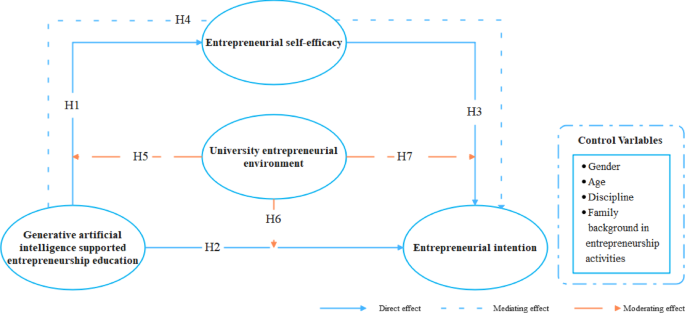
H1: Generative artificial intelligence supported entrepreneurship education positively influences entrepreneurial self-efficacy.
Generative artificial intelligence supported entrepreneurship education and entrepreneurial intention
GAISEE, characterized by its interactive and immersive features, presents a novel and dynamic learning platform for students, significantly influencing their entrepreneurial intentions11. In alignment with the Theory of Planned Behavior, which underscores that behavioral intentions are direct precursors to actual behavior, GAISEE exerts a substantial influence on students’ attitudes, subjective norms, and perceived behavioral control regarding entrepreneurship21. Through GAISEE courses, students are afforded the opportunity to engage in realistic business simulations, thereby enhancing their problem-solving and decision-making capabilities and fostering greater confidence in their ability to succeed in entrepreneurial ventures27. For instance, students can use generative AI tools to develop and refine business models, simulate market entry strategies, and even practice pitching their ideas to virtual investors, receiving immediate, tailored feedback5. This hands-on experience not only equips them with practical skills but also reinforces their belief in their entrepreneurial potential. The design of these courses aligns with the latest understanding of generative learning principles, encouraging students to actively explore, experiment, and learn through a self-directed process28. The application of AI to enhance experiential learning and authentic assessment through realistic scenarios and feedback mechanisms further improves the relevance of the educational content for students26.
Furthermore, interaction with AI technology within the GAISEE framework enables students to better perceive and assess the risks and opportunities inherent in the entrepreneurial process, thereby cultivating a more positive and proactive entrepreneurial attitude28. According to social cognitive theory, such a positive attitude is a critical driver of entrepreneurial behavior29. The implementation of GAISEE also reinforces subjective norms; students often collaborate in teams within simulated environments, which enhances their teamwork skills and creates a perception of social support for entrepreneurial actions through peer interactions and mentorship from experienced entrepreneurs facilitated by the platform7. Consequently, students may feel recognized and encouraged by their peers and mentors to pursue entrepreneurial paths, further bolstering their entrepreneurial intention. From the perspective of perceived behavioral control, the AI components within GAISEE courses deliver real-time feedback and personalized assistance, empowering students to effectively address entrepreneurial challenges and mitigating self-doubt about their ability to execute entrepreneurial activities successfully26. This targeted support enhances students’ self-perception of possessing the necessary skills and resources to undertake and complete entrepreneurial tasks, thus strengthening their control over entrepreneurial behavior. As an innovative and transformative approach to entrepreneurship education, GAISEE significantly enhances students’ entrepreneurial intention by positively influencing the psychological factors associated with entrepreneurship14. Therefore, this study proposes the following hypothesis:
H2: Generative artificial intelligence supported entrepreneurship education positively influences entrepreneurial intention.
Entrepreneurial self-efficacy and entrepreneurial intention
Entrepreneurial self-efficacy stands as a cornerstone in the formation of an individual’s entrepreneurial intention, reflecting a robust belief in one’s own capabilities to successfully navigate the entrepreneurial landscape32. Within the framework of the Theory of Planned Behavior, entrepreneurial self-efficacy aligns closely with the concept of perceived behavioral control, which is a critical determinant of behavioral intention21,23. A strong sense of entrepreneurial self-efficacy has been empirically demonstrated to exert a positive influence on an individual’s entrepreneurial intention33. This is because heightened confidence in one’s entrepreneurial abilities enhances the motivation and resolve to engage in entrepreneurial activities. Individuals with high entrepreneurial self-efficacy are more likely to perceive entrepreneurial challenges as surmountable and view entrepreneurship as a viable and attractive career path15.
Conversely, a deficiency in entrepreneurial self-efficacy can significantly dampen one’s entrepreneurial aspirations and intentions. A primary objective of effective entrepreneurship education is to cultivate and strengthen students’ entrepreneurial self-efficacy, thereby building their confidence and fostering positive expectations regarding their entrepreneurial capabilities34. GAISEE plays a crucial role in this process by providing students with simulated entrepreneurial experiences and personalized feedback, which effectively raise their entrepreneurial self-efficacy35. Through these immersive and interactive learning experiences, students gain practical insights and develop a stronger belief in their ability to succeed, which in turn, strengthens their desire and plans to pursue entrepreneurial activities in the future. For instance, by engaging in AI-simulated business challenges, students can test their decision-making skills and receive immediate feedback on their performance, reinforcing their confidence in their entrepreneurial abilities. Therefore, this study proposes the following hypothesis:
H3: Entrepreneurial self-efficacy positively influences entrepreneurial intention.
The mediating effect of entrepreneurial self-efficacy
The relationship between GAISEE and entrepreneurial intention cannot overlook the concept of entrepreneurial self-efficacy, which is the confidence in one’s ability to execute entrepreneurial activities35,36. Entrepreneurial self-efficacy plays a crucial role in the formation of entrepreneurial intention35 and is considered a psychological state reflecting an individual’s self-assessment of their ability to identify opportunities, mobilize resources, and apply strategies for effective entrepreneurship23. While the foundational Theory of Planned Behavior (TPB) introduced Perceived Behavioral Control (PBC) – a construct closely related to self-efficacy – as a direct antecedent of intention13and some recent discussions have explored its potential moderating influences, the specific role of entrepreneurial self-efficacy in the context of educational interventions is strongly supported in the literature as a mediator. Educational programs, particularly innovative approaches like GAISEE, are designed to directly build and enhance specific competencies and the belief in one’s ability to perform related tasks5,27. In this vein, GAISEE provides students with simulated entrepreneurial experiences, personalized feedback, and opportunities to apply generative AI tools, all of which are posited to directly enhance their entrepreneurial self-efficacy28. This newly acquired or strengthened entrepreneurial self-efficacy then serves as a critical psychological mechanism that translates the educational experience into a heightened entrepreneurial intention. Numerous contemporary studies within entrepreneurship education empirically support this mediational pathway. For instance, Al-Qadasi et al.23 and Amani et al.25 found that entrepreneurial self-efficacy significantly mediates the relationship between entrepreneurship education and entrepreneurial intentions. Similarly, Wang et al.36 and Taneja et al.24 demonstrated the mediating effect of entrepreneurial self-efficacy in linking educational or experiential inputs to entrepreneurial outcomes. Bachmann et al.11 also highlighted entrepreneurial self-efficacy as a key mediator in the process through which digital competencies translate into entrepreneurial intention. Therefore, conceptualizing entrepreneurial self-efficacy as a mediator aligns with the logic that GAISEE fosters a belief in one’s capabilities (entrepreneurial self-efficacy), which subsequently fuels the intention to pursue entrepreneurial endeavors. This psychological mechanism enables GAISEE to stimulate and enhance students’ entrepreneurial intention by improving their self-efficacy. Based on the theoretical and practical understanding of entrepreneurial self-efficacy, this study proposes:
H4: Entrepreneurial self-efficacy mediates the relationship between generative artificial intelligence supported entrepreneurship education and entrepreneurial intention.
The moderating effect of university entrepreneurial environment
A supportive university entrepreneurial environment plays a critical role in amplifying the effectiveness of entrepreneurship education and catalyzing students’ entrepreneurial potential by providing essential resources, mentorship, and a nurturing culture25. The optimization of the university ecosystem, encompassing factors such as a vibrant entrepreneurial atmosphere, supportive policies, and strategic resource allocation, significantly enhances students’ engagement with GAISEE. This, in turn, deepens their understanding of entrepreneurial concepts and cultivates their ability to apply these concepts in practical settings37. By fostering a positive learning atmosphere and offering ample opportunities for hands-on experience, a strengthened entrepreneurial context enables GAISEE to more effectively nurture students’ entrepreneurial self-efficacy38. Functioning as an external catalyst in generative AI-based education, the entrepreneurial environment provides students with increased access to enterprise collaborations, mentorship opportunities, and crucial resources31. These supportive measures facilitate students’ mastery of entrepreneurial knowledge and significantly boost their confidence in applying this knowledge to real-world entrepreneurial practice.
When universities actively encourage entrepreneurial activities, provide necessary resources, and foster collaborations with businesses, students are more inclined to transform the knowledge and skills acquired through GAISEE into concrete entrepreneurial motivations and actionable plans39. The entrepreneurial context not only offers educational resources and cultivates an entrepreneurial culture, thereby enriching and practicalizing the entrepreneurship education process, but it also provides valuable networks and platforms that promote the integration of students’ innovative thinking with their practical abilities38. This integration is crucial for helping students develop a clearer and more robust entrepreneurial intention. A supportive university ecosystem can significantly enhance the educational impact of GAISEE, ensuring that the experiences and learning gained in the course have a more profound and lasting influence on students’ future entrepreneurial decisions39. Moreover, an exemplary university entrepreneurial environment can inspire students to actively participate in entrepreneurial competitions, workshops, and other extracurricular activities, which further strengthens the entrepreneurial knowledge and skills obtained through GAISEE and paves the way for their future entrepreneurial endeavors40.
The university entrepreneurial environment exerts a direct influence on students’ perceptions of entrepreneurial behavior and indirectly impacts the development of their entrepreneurial capabilities and the formation of their entrepreneurial intention by providing essential resources and support41. Key supportive aspects of the university ecosystem include fostering an encouraging entrepreneurial spirit on campus, providing readily available entrepreneurial resources and guidance, and establishing close ties with business practices38. These elements collectively create a robust ecosystem that reinforces students’ entrepreneurial experiences and skill development, enabling entrepreneurship education to achieve superior practical outcomes21. An optimized environment facilitates the effective transformation of entrepreneurial self-efficacy into entrepreneurial intention, increasing the likelihood that students will put the entrepreneurial skills and mindsets they have learned into practice38. In a positive entrepreneurial context, the entrepreneurial support and confidence students perceive are more likely to translate into actual entrepreneurial action intentions25. Therefore, this study posits:
H5: University entrepreneurial environment positively moderates the relationship between generative artificial intelligence supported entrepreneurship education and entrepreneurial self-efficacy.
H6: University entrepreneurial environment positively moderates the relationship between generative artificial intelligence supported entrepreneurship education and entrepreneurial intention.
H7: University entrepreneurial environment positively moderates the relationship between entrepreneurial self-efficacy and entrepreneurial intention.
Research model
The research model constructed in this study aims to explore the mechanisms through which GAISEE affects university students’ entrepreneurial intention and the moderating role of the university entrepreneurial environment. Figure 1 presents an integrated model that includes independent, dependent, mediating, moderating, and control variables, striving to comprehensively reveal how GAISEE influences students’ entrepreneurial intention through entrepreneurial self-efficacy and examines how university entrepreneurial environment optimizes this process. To account for potential confounding factors and enhance the robustness of our findings, we included several control variables in our analysis: gender, age, academic discipline, and family background in entrepreneurship. The inclusion of these variables was based on existing literature suggesting their potential influence on entrepreneurial intentions and related constructs. Prior research has indicated that gender differences may exist in entrepreneurial intentions, self-efficacy, and perceptions of the entrepreneurial environment10. Including gender as a control variable allows us to isolate the effects of GAISEE while accounting for potential gender-based variations. Age has also been identified as a factor that can influence entrepreneurial intentions, with younger individuals often exhibiting higher levels of entrepreneurial aspiration. Controlling for age helps ensure that the observed effects are not merely due to age-related differences. Students from different academic disciplines may have varying levels of exposure to entrepreneurship concepts and varying predispositions toward entrepreneurial careers42. For instance, business students might inherently possess higher entrepreneurial intentions compared to those from other fields. Controlling for academic discipline allows us to account for these potential differences. Prior exposure to entrepreneurship through family businesses can significantly influence an individual’s entrepreneurial intentions and self-efficacy. Individuals with a family background in entrepreneurship may have different motivations, resources, and support systems compared to those without such a background. Controlling for this variable helps isolate the unique impact of GAISEE43.

link