Integrating team-based and peer-teaching strategies for standardized dental residency: a path to active learning and professional growth | BMC Medical Education

Demographics and baseline information of the students
A total of 82 undergraduate students were recruited for this study, with 39 students in the 2021-22 cohort and 43 students in the 2022-23 cohort. Demographic and baseline information of the students are summarized in Table 1. No statistically significant differences were observed between the two cohorts in gender distribution (χ² = 0.0104, P = 0.918), age (22.9 ± 0.88 vs. 23.1 ± 0.91 years; t = 1.011, P = 0.315), or entrance exam scores (82.4 ± 8.41 vs. 83.5 ± 7.62; t = 0.617, P = 0.539). These findings demonstrate the baseline equivalence of the two cohorts, ensuring comparability for subsequent analyses.
Theoretical knowledge assessment
Theoretical knowledge assessment was conducted in a format similar to the national residency training completion examination. The comparison of pre- and post-course test scores between the two cohorts were shown in Fig. 2. No significant difference was observed in scores before standardized residency training (83.5 ± 7.62 vs. 82.4 ± 8.41, P > 0.05). After 3-month training, the 2022-23 cohort, which received the TBL + PT teaching approach, demonstrated significantly higher theoretical test scores compared to the 2021-22 cohort (83.74 ± 6.60 vs. 73.46 ± 8.68, P < 0.001) (Fig. 3).

Pre- and post-course theoretical knowledge test scores between 2021-22 and 2022-23 cohorts
Clinical skills assessment

Clinical skills assessment of the students
In the TBL + PT group, the training employed a collaborative teaching approach to enhance students’ active learning capabilities and teamwork skills. The 2022-23 cohort, exhibited significantly higher overall performance in clinical skills compared to the 2021-22 cohort (Total score: 85.09 ± 2.43 vs. 76.70 ± 4.18, P < 0.001), as shown in Table 2; Fig. 2.
Patient Intake represent a comprehensive station assessing critical aspects of patient management, including medical history taking and clinical examination, medical record documentation, and doctor-patient communication. A marked improvement was found in the 2022-23 cohort (93.00 ± 2.61 vs. 73.36 ± 6.96, P < 0.001). These findings highlight the advantages of active learning strategies in fostering communication skills, clinical reasoning, and professionalism.
For technical skills assessed via the OSCE, the TBL + PT (2022-23) cohort consistently outperformed the traditional cohort across multiple stations. In Pulpotomy, Tooth Preparation, Incision and Suturing, as well as Curettage, the TBL + PT cohort achieved significantly higher scores than traditional teaching cohort (88.30 ± 3.81 vs. 76.92 ± 7.91, P < 0.001; 90.93 ± 2.20 vs. 76.18 ± 8.20, P < 0.001; 91.00 ± 2.83 vs. 79.00 ± 7.21, P < 0.001; 84.00 ± 4.08 vs. 73.64 ± 7.66, P < 0.001 respectively), reflecting superior mastery of procedural accuracy, adherence to clinical protocols, and critical understanding of key techniques in students who in TBL + PT cohort.
However, no significant differences were observed in Rubber Dam Placement (79.35 ± 8.03 vs. 78.33 ± 7.54, P = 0.569) or Periodontal Probing (77.12 ± 8.44 vs. 76.13 ± 8.17, P = 0.591), suggesting that these routinely practiced skills may not have been as influenced by the advanced teaching methodology.
Student engagement
The SCEQ was used to assess the level of student engagement. The comparison of four key dimensions of engagement scores between the 2021-22 and 2022-23 cohorts is presented in Table 3.
While the 2022-23 cohort showed higher scores in skills engagement (33.1 ± 7.14 vs. 30.2 ± 6.88), the difference was not statistically significant (P = 0.064). However, significant improvements were observed in emotional engagement (20.6 ± 2.86 vs. 17.7 ± 3.76, P < 0.001) and participation/interaction engagement (25.5 ± 3.38 vs. 22.4 ± 4.12, P < 0.001), suggesting that the active and collaborative teaching strategies fostered stronger emotional connections and greater teamwork among students. Performance engagement scores were comparable between the two cohorts (12.3 ± 1.69 vs. 12.4 ± 1.77, P = 0.794), indicating that both teaching methods had a similar influence on this dimension. Notably, the total engagement score was significantly higher in the TBL + PT cohort (91.5 ± 8.57) compared to the traditional cohort (82.7 ± 9.03, P < 0.001), highlighting the effectiveness of the TBL + PT model in increasing student engagement and promoting active learning during oral medicine residency training.
The correlation between student engagement (SCEQ scores) and academic outcomes (theoretical test scores) were further evaluated with Pearson correlation analysis. The results showed a significant positive correlation in both the 2021–22 cohort (r = 0.7235, p < 0.0001) and the 2022–23 cohort (r = 0.6727, p < 0.0001), indicating that higher levels of student engagement were associated with better academic performance.
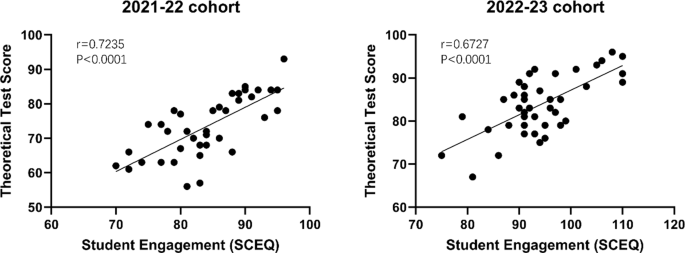
Correlation between student engagement (SCEQ) and theoretical test scores in the 2021–22 and 2022–23 cohorts
Student satisfaction
The results of the Student Satisfaction Survey (SSS) revealed a significant difference in satisfaction scores between the two groups (t = -3.13, P = 0.0025). The traditional teaching group had an average SSS total score of 60.6 ± 4.32, while the group utilizing the new teaching method scored significantly higher at 63.4 ± 3.73.
Further analysis identified specific survey items with significant differences between the two cohorts (Table 4). Students in the 2022-23 cohort reported higher satisfaction with the teaching and mentoring process (Question 8, t = -2.082, P = 0.0398), the institution’s efforts to improve teaching quality (Question 15, t = -2.22, P = 0.029), and the use of student-centric teaching methods (Question 16, t = -3.14, P = 0.0023). These findings collectively highlight the potential of innovative teaching strategies to not only improve overall satisfaction but also address specific domains of the educational experience, including mentoring, continuous quality improvement, and the adoption of student-centric learning methods.
Students’ feedback
The word clouds shown in Fig. 4 illustrate the key themes from students’ feedback for 2 cohorts. In the 2021–22 cohort, students frequently highlighted terms such as “comprehensive,” “experienced,” “clear,” and “thorough,” reflecting their appreciation for structured and detailed course content as well as the professionalism and expertise of the instructors. In contrast, the 2022–23 cohort emphasized terms like “teamwork,” “collaboration,” “participation,” and “innovative,” suggesting a shift in focus toward active learning, peer interaction, and innovative teaching approaches. These differences indicate that while both cohorts valued the quality of their educational experiences, the 2022–23 cohort benefited more from interactive and collaborative learning methodologies (Fig. 5).

Word clouds of the (A) 2021-22 cohort and (B) 2022-23 cohort
link