


Study design
A mixed-methods study was designed to examine the role of instructional design in the advanced nursing practice course based on the ARCS motivation model. The quantitative part employed a quasi-experimental study designed with pre-and post-intervention, and the qualitative part used a descriptive qualitative design with semi-structured individual interviews.
Participants and setting
Researchers recruited 31 first-year full-time nursing graduate students from a university in Southern China, all of whom agreed to participate in the study. The Advanced Nursing Practice course is a required class for first-year nursing graduate students, offered in their second semester. These students had already taken similar theory and nursing courses and had a certain foundational knowledge.
Participation in research was not a prerequisite for participation in this course. Registered students were invited to participate in research, but this was voluntary and will not affect academic performance whether they participate or not. Students were informed that the data collected was confidential and would only be used for research purposes. Classes were provided with information about the educational program of the course, including an explanation of the voluntary nature of their participation and the option to withdraw at any time. The data collection procedure was initiated with the consent of the participants. The ethical application was approved by the university’s ethics committee (approval number: [2024] 326).
Advanced nursing practice course introduction
In China, the advanced nursing practice course is a core course for graduate nursing students. It prepares nursing master’s students to apply high-level theories, skills, and research competencies to address patient issues within clinical specialties. The course requires not only solid theoretical knowledge and clinical skills, but also critical thinking and patient-centered decision-making abilities. The textbook used for this course is listed in the 13th Five-Year Plan issued by the National Health and Family Planning Commission, and is supplemented by a casebook as a teaching aid.
The course has complexity and involves the use of a multidisciplinary model to solve difficult clinical cases. The course content focuses on course introduction, advanced nursing practice development and its relevant theories, Advanced Practice Nurse development, individualized advanced nursing practice, group-based advanced nursing practice, advanced nursing practice in intravenous therapy, plumbing, wound stoma, and midwifery, international perspectives on advanced nursing practice, and advanced nursing practice research and applied cases. After the course, there will be 18 months of nursing clinical practice, and for students to achieve advanced nursing practice levels and improve their learning motivation, self-learning ability, and critical thinking.
Intervention program
A 9-week advanced nursing practice course of 36 classroom hours for 2 credits was conducted in 2024 for 31 first-year full-time graduate nursing students. This instructional design was based on a ten-step process of the ARCS motivation model proposed by Professor Keller [15] as a basis for designing a framework of motivational instructional design. (Fig. 1)

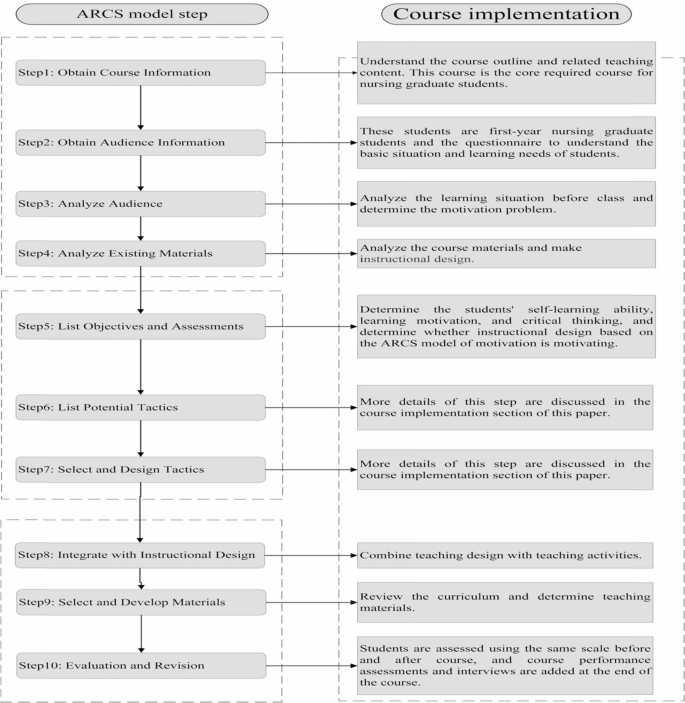
The framework of instructional design follows the ten-step ARCS motivation model
Preparation
Students preparation
During the course preparation, students completed a brief open-ended questionnaire solely for the teaching team to understand their learning needs and interests. Participation was voluntary and anonymous; responses were not used in the research analysis.
Faculty preparation
This course was hosted by a senior nursing practice team in a university in southern China, which consists of 2 Internationally recognized Professors of Nursing, 1 PhD in Nursing, 1 PhD in Statistics, and 4 Clinical Advanced Nursing Practice Specialists from different hospitals. Adopting a student-centered approach, the team carefully identified limitations in the traditional course, conducted a comprehensive analysis of students’ learning status, and pursued research-informed improvements. Before the implementation of this intervention study, the teachers of this course team received theoretical training on the ARCS model. Referred to the research articles of Professor Keller, who developed the ARCS motivation model and designed a teaching design plan based on the ARCS motivation model combined with the characteristics of the course in Table 1.
Implementation
This course adopted a teacher-guided, student-centered approach, and we have constructed the “4E” teaching process, which was a whole process, multi-stage online and offline blended teaching mode consisting of active Engagement before class, knowledge Exploration in class, knowledge Experience after class, and knowledge Expansion after class. We employed various teaching methods, including team-based learning (TBL), problem-based learning (PBL), and case-based learning (CBL), evidence-based thinking method, among others.
Active engagement before class
Before the class, the faculty team used the online learning platforms to upload relevant learning materials for the course, such as courseware, videos, cases, relevant literature, etc. and assigned pre-course tasks. Students could preview the online course, complete pre-course tasks, review past knowledge, and read real clinical cases through the online learning platforms. Teachers encouraged students to raise questions and ideas on the course platform after previewing the course so that teachers could provide timely answers to students’ questions.
Knowledge exploration in class
The ancient Chinese book “The Doctrine of the Mean” mentions, “Broadly learn, thoroughly ask, carefully think, debate wisely, and steadfastly put into the act [22]”. We have used this classic quotation to establish a step-by-step, inquiry-driven approach, encompassing “Learning, Asking, Thinking, Debating, and Acting”. (1) Learning: Teachers used teaching resources such as courseware, case studies, and videos to deliver a thorough presentation of the content around the teaching objectives. (2) Asking: After the teacher’s lesson, students shared their queries and took the initiative to summarise their problems to the teacher. (3) Thinking: Students completed a pre-course task assigned by the teachers, where students engaged in group discussions that were problem-driven, reviewed literature and information based on evidence-based evidence grading, created coursework, and reported back. (4) Debating: After completing the task debriefing, students debated the points made in the debriefing as well as the questions posed by the teacher. At the end of the debate, the teacher pointed out the strengths of the report and areas for improvement and encouraged students to judge it with a dialectical concept. At the end of the class, there would be a teacher’s evaluation and a student’s mutual evaluation. (5) Acting: The teacher assigned tasks after class, asking students to utilize the virtual simulation software developed by the teacher’s team to carry out relevant course exercises, as well as reviewing the content of the course. Additionally, after class, teachers would upload outstanding student learning outcomes to an online platform to facilitate continued mutual learning among students.
Knowledge experience after class
After class, students went to the school’s advanced nursing practice laboratory and affiliated hospitals for clinical practice. In this module, students selected cases based on faculty guidance and applied higher-order nursing theory, skills, and research competencies to patient problems in a clinical specialty area. Teachers encouraged students to articulate their insights and reflections on handling clinically complex cases through a written paper.
Knowledge expansion after class
After class, the teacher encouraged students to apply the knowledge acquired in the classroom to participate in academic conferences, helping them translate their reflections on complex clinical cases into research activities. In addition, teachers lead students to actively participate in community volunteering on themes such as ‘whole life care’ to better understand the needs of patients and promote health knowledge.
Evaluation
Quantitative and qualitative data were collected to gain a comprehensive understanding of the effectiveness of instructional design based on the ARCS motivation model. Students’ learning motivation, self-learning ability, and critical thinking were assessed both at the beginning and at the end of the course. The course has also been designed with a multi-form test to evaluate students’ mastery of knowledge. In addition, semi-structured interviews were conducted after the completion of the course.
Learning motivation
The Working Preference Inventory (WPI), developed by Amabile et al. in 1994, was designed to assess endogenous and exogenous motivation [23]. The inventory comprises two distinct versions tailored for adults and students, aimed at measuring work motivation and learning motivation, respectively. In 2006, Liping Chi introduced, revised, and culturally adapted the student version of the WPI to evaluate motivation among college students in China [24]. The revised version has 30 items, including two dimensions of endogenous motivation (self-determination, competence, task commitment, curiosity, enjoyment, and fun) and exogenous motivation (competition, evaluation, recognition, monetary or other incentives, and other constraints). The scale is scored on a four-point Likert scale, with higher scores indicating stronger levels of motivation. The scale has good reliability and validity.
Self-learning ability
The Self-learning Ability Scale was adopted to anonymously evaluate students’ self-learning ability in nursing students [25]. The scale has 28 items in three dimensions, including self-management, information management, and learning cooperation. Among them, ten questions are self-management, 11 questions are information management, and seven questions are learning cooperation. A five-point Likert scale was used for rating from 1 (completely disagree) to 5 (completely agree), with total scores ranging from 28 to 140 points. Higher scores indicate better self-learning abilities. The total score of more than 84 indicates that the independent learning ability is higher than the medium level. Otherwise, it is lower than the medium level. The Cronbach’s coefficient of the scale was 0.8632, and the partial reliability of the total volume table was 0.7656. At present, the scale has been widely used by nursing students.
Critical thinking disposition
The Critical Thinking Disposition Inventory of Chinese Version (CTDI-CV) [26]was adopted to evaluate nursing students’ critical thinking ability. This scale includes seven dimensions, which were truth-seeking, open-mindedness, analysis ability, systematization ability, self-confidence in critical thinking, inquisitiveness, and cognitive maturity, with a total of 70 items. Each dimension consisted of 10 items and used a six-point Likert scale from 1 (strongly disagree) to 6 (strongly agree). The total score ranged from 70 to 420, with scores over 280 indicating a positive critical thinking tendency. Each dimension that scores < 40 represented a weak disposition, and ≥ 40 indicated a positive disposition. The Cronbach’s alpha values ranged from 0.54 to 0.77 for the seven dimensions and 0.90 for the total scale.
A multi-form test
The multi-form test is designed to assess the students’ mastery and application of the course. The test is worth a total of 100 marks and consists of task debriefing, construction of a nursing intervention plan, and reflective diary writing. All three types of evaluation assessed students’ knowledge, skills, and humanistic qualities. Structured grading rubrics were developed for each assessment component. Except for the “student mutual evaluations” during task presentations, all other evaluations were independently conducted by the course instructor. Figure 2 provides characteristics of the multi-form test composition.

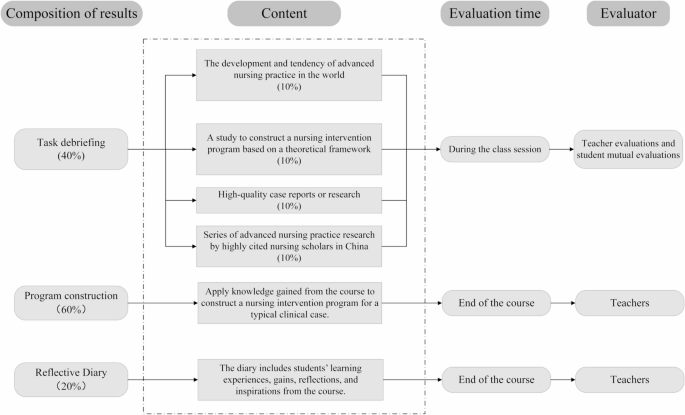
Characteristics of the multi-form test composition
Semi-structured interviews
Individual semi-structured interviews were conducted to collect a rich set of qualitative data to complement the quantitative information. The interviewer was a second-year postgraduate student in our research group who had received training in a university course on “Qualitative Research Methods”. Before the interview, the researcher built trust with the students, explained the purpose of the interview, and obtained their verbal consent for the study. To ensure the authenticity of the results, the interviewer repeatedly emphasized to the students that the results of the interview were not related to their academic performance, but only to understand their real learning experiences. Interviewees were selected from the recruited students until saturation was reached, and nothing new about the research topic emerged during the interviews. The interviews were held in classrooms or dormitories, based on the students’ preferences, fostering a comfortable atmosphere that allowed interviewees to engage without pressure, resulting in believable outcomes. Each interview lasted approximately 30 min and was transcribed immediately after the interview was recorded.
The interview outline included the following questions, “How do you feel about the advanced nursing practice course? What did you learn from the course? Does the course’s training program increase your learning motivation? Does the course improve your self-learning ability? Does the program’s curriculum develop your critical thinking? What have you learned from the course that will inspire your future work? “.
Data analysis
Data were analyzed using IBM SPSS 27.0 software. Frequency, percentage, mean, and standard deviation were used to describe demographic characteristics. Means were used to describe participants’theoretical scores. Normality tests were performed on the differences in the scores of the pre-test and post-test of each scale, and they all conformed to a normal distribution. Paired-sample t-tests were used to compare differences between pretest and post-test scores, with P < 0.05 indicating significance for all tests.
For the qualitative data, the Colaizzi analysis method was used [27]. The audio recordings were transcribed into text within 24 h. Subsequently, the two authors meticulously reviewed all the transcripts to familiarize themselves with the data. They extracted significant statements pertinent to the study objectives and analyzed the codes derived from the text. The codes were subsequently categorized into thematic groups, with comprehensive descriptions provided for each group. Ultimately, analogous viewpoints were consolidated to establish the conclusive themes. The NVivo 11.0 software facilitated data administration and analysis.
link